
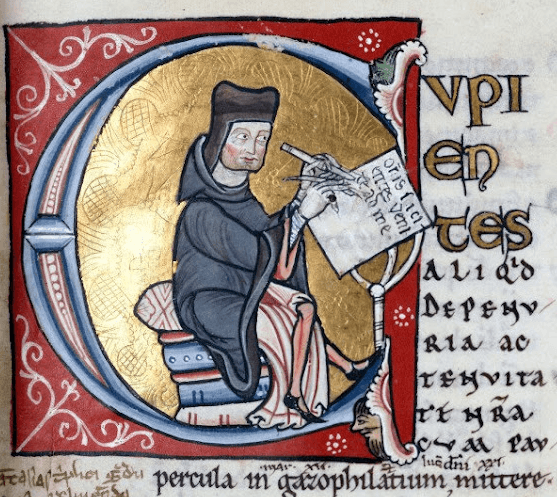
Peter Lombard was born to a poor family in the Lombard town of Novara, and rose through episcopal patronage — first of the Bishop of Lucca, then of Bernard of Clairvaux, who recommended him to the canons of Saint-Victor in Paris around 1136. He taught at the cathedral school of Notre-Dame in Paris for two decades, and at the end of his life — in the year of his death — he was briefly Bishop of Paris (1159–60).
Around 1150–52 he completed the Sentences (Sententiae in Quatuor Libris Distinctae) — a four-book systematic compendium of Christian doctrine drawn entirely from patristic and conciliar authorities, organized topically and dialectically. The four books treat (1) God and the Trinity, (2) creation and sin, (3) the Incarnation and the virtues, (4) the sacraments and the Last Things. For the next four hundred years the Sentences was the basic textbook of theology in every Western university; Aquinas, Bonaventure, Scotus, Ockham, and Luther all wrote commentaries on it as the canonical first step in their theological careers.
Though never formally canonized — and never in fact considered for canonization — he is venerated in the Catholic tradition as 'the Master,' the architect of the scholastic method that defined Latin theology from the late twelfth century to the Council of Trent. His tomb at Saint-Marcel in Paris was destroyed at the French Revolution.