
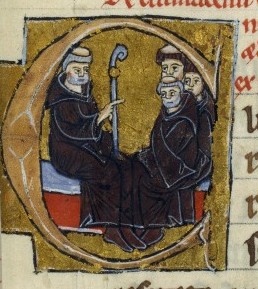
Peter of Montboissier, of the Auvergnat nobility, entered Cluny under Hugh the Great, became prior of Vézelay and then of Domène, and was elected ninth Abbot of Cluny in 1122 at the age of thirty. He held the office for thirty-four years and was the last great Cluniac abbot.
His abbacy was dominated by reform — restoring Cluny's finances after the disastrous tenure of his predecessor Pons of Melgueil, tightening monastic discipline, and engaging in lifelong friendly debate with Bernard of Clairvaux over the relative merits of Cluniac and Cistercian observance (their correspondence is one of the most graceful exchanges in medieval Latin letters). He gave shelter to Peter Abelard after Abelard's condemnation at the Council of Sens in 1141 and presided over the philosopher's reconciliation with Bernard and his peaceful death at the Cluniac priory of Saint-Marcel near Chalon.
His most original act was commissioning, in 1142–43, the first Latin translation of the Qur'ān — the so-called Toledan Collection — together with a corpus of supporting Arabic-Christian texts, to make it possible (as he wrote) to refute Islam by argument rather than by ignorance. He died at Cluny on Christmas Day 1156 and is venerated as Blessed; the formal title 'Venerable' attached to him almost immediately in the Cluniac calendar.