
Petroc (Cornish Pedrek, Welsh Pedrog) was — per the 12th-century Vita Sancti Petroci composed at Bodmin Priory in Cornwall — born to the royal family of the Cumbric-Welsh kingdom of Glywysing in southeastern Wales around 470 AD. He was sent as a young man to Ireland for the standard Brittonic-Celtic monastic education that was the educational tradition of the post-Roman Brittonic Christian world.
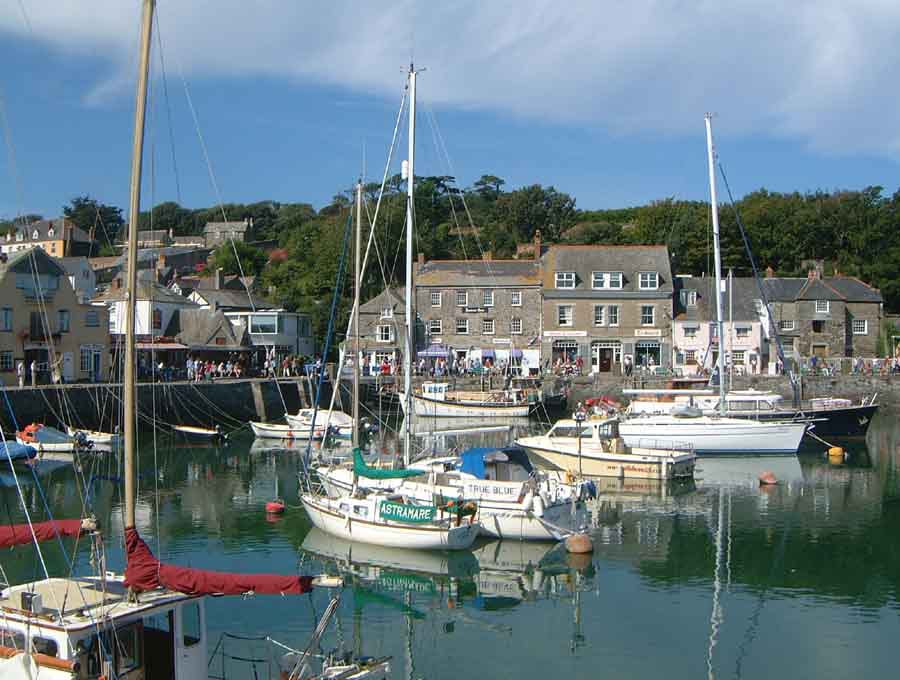
After his Irish formation, Petroc returned to Britain and travelled to Cornwall — the Brittonic-Celtic Christian territory of the southwestern peninsula — where he established a monastic foundation at the small Cornish coastal village of Padstow (the Cornish-Christian name Petrocstow, 'Petroc's place,' preserves the establishment). The foundation became — across the late 5th and 6th centuries — the principal Catholic monastic foundation of Cornwall.
Petroc's pastoral work across Cornwall produced an extraordinary range of small monastic foundations, parish churches, and hermit-cell holy-well shrines across the entire Cornish peninsula. The Cornish hagiographic tradition records over thirty individual Cornish churches founded by Petroc personally, plus an extensive web of small foundations under his direct disciples. The medieval Cornish Catholic identity was substantially built on the Petroc-web; he is the father of Cornish Catholic-Christian identity in the same way that David is the father of Welsh Catholic-Christian identity.
He died at Padstow on June 4, 564. His relics — preserved at the Padstow shrine through the medieval period — were translated in 1177 to the inland Cornish-Catholic centre at Bodmin Priory (a Norman-period Augustinian Canons' foundation that became the principal medieval Cornish pilgrimage destination). The Bodmin reliquary of Petroc — a Sicilian-Norman ivory casket of Limoges-enamel work, one of the great surviving 12th-century European reliquaries — was famously stolen by Walter of Coutances in 1177 and translated to Saint-Méen in Brittany, only to be recovered after substantial Norman royal intervention. The reliquary, recovered in 1184, is preserved at the Bodmin Parish Church and is the surviving medieval Cornish-Catholic religious object.