Felipe de las Casas was born in Mexico City in 1572, the son of Alonso de las Casas and Antonia Ruiz Martínez, Spanish settlers, and was baptised in the cathedral of Mexico City. By every account he was a restless, unserious boy. As a young man he entered the novitiate of the Discalced Franciscans at Puebla — the province of San Diego, founded by St. Pedro Bautista, with whom he would one day die — and left it after a few months.
His father sent him to Manila to make his way in trade, and for a time, the Franciscans say, he lived there for pleasure. In 1590 he went back to the friars, at Manila, and took the name Felipe de Jesús; he made his profession in 1594. Because the see of Manila was vacant he was to be ordained priest in Mexico, and on 12 July 1596 he sailed for home aboard the galleon San Felipe.
A storm drove the ship onto the coast of Japan, at Urado in Shikoku, in October 1596. The provincial governor seized it and held its crew and passengers, and the ruler Toyotomi Hideyoshi was told that the Spanish friars were the forerunners of a conquest — a claim, the Catholic Encyclopedia notes, that one of the crew had falsely made. Felipe went to the Franciscan house at Miako, Kyoto. On 8 December 1596 Hideyoshi ordered the friars there arrested; though not yet a priest, he chose to share their lot.
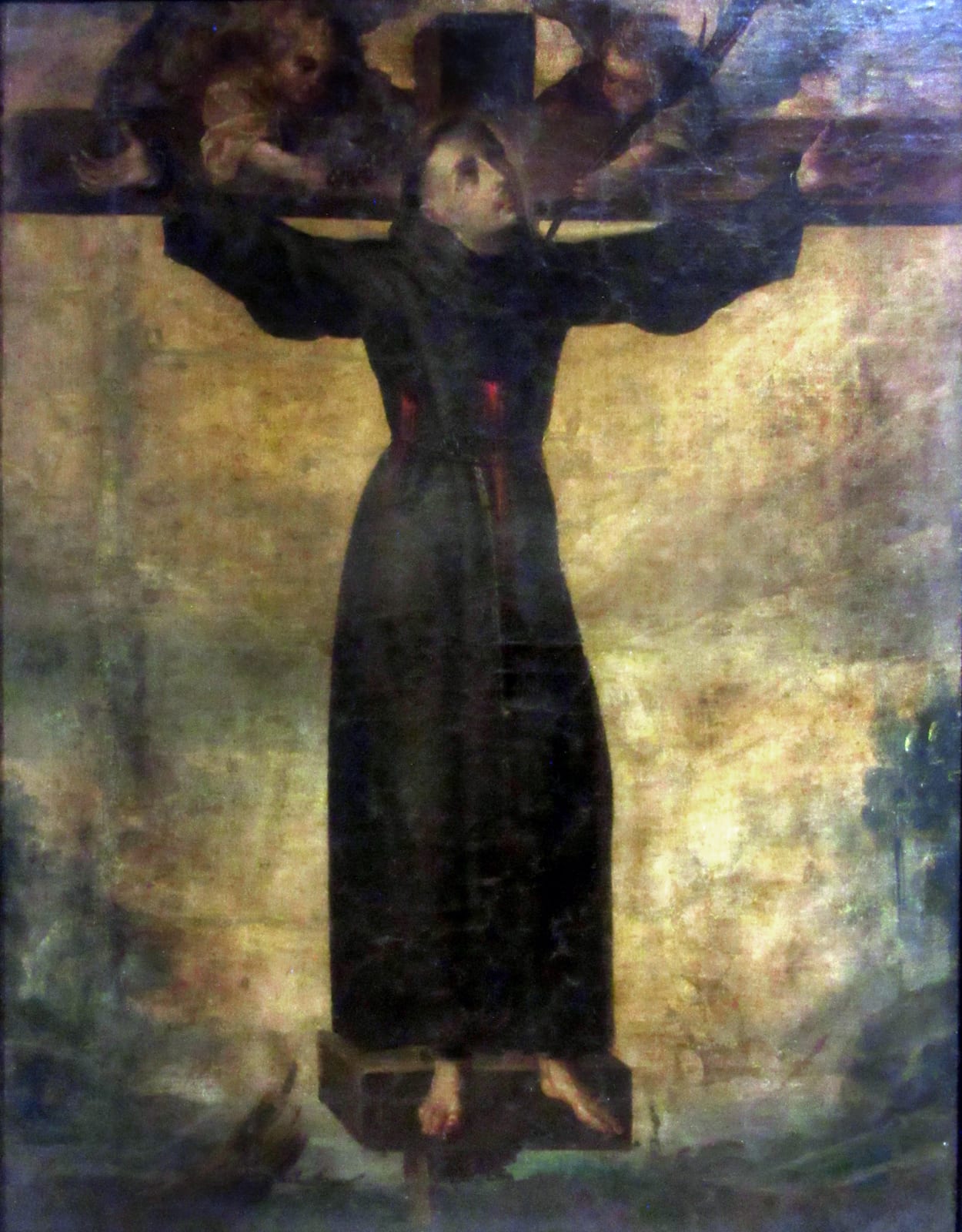
On 3 January 1597 the prisoners — six Franciscans, the Jesuit Paul Miki and two Jesuit catechists, and seventeen Japanese laymen — had their ears cropped and were paraded through Kyoto, then marched by way of Osaka to Nagasaki, where they arrived on 5 February. That day they were bound to crosses on Nishizaka Hill above the harbour and pierced with lances. Felipe was twenty-four. The tradition of his country holds that he died the first of them all; José María Montes de Oca's engraved Life of 1801 says so in its caption — 'the first of his companions, crucified and pierced with three lances, winning thereby the palm of Protomartyr among those same Protomartyrs.'
Urban VIII beatified the twenty-six in 1627, and Pius IX canonised them on 8 June 1862. Mexico keeps him as its first saint and its protomartyr, and Mexico City as its patron; his feast there is the day of his death, 5 February. His fellow martyrs share a page on this site, under St. Paul Miki and companions.