
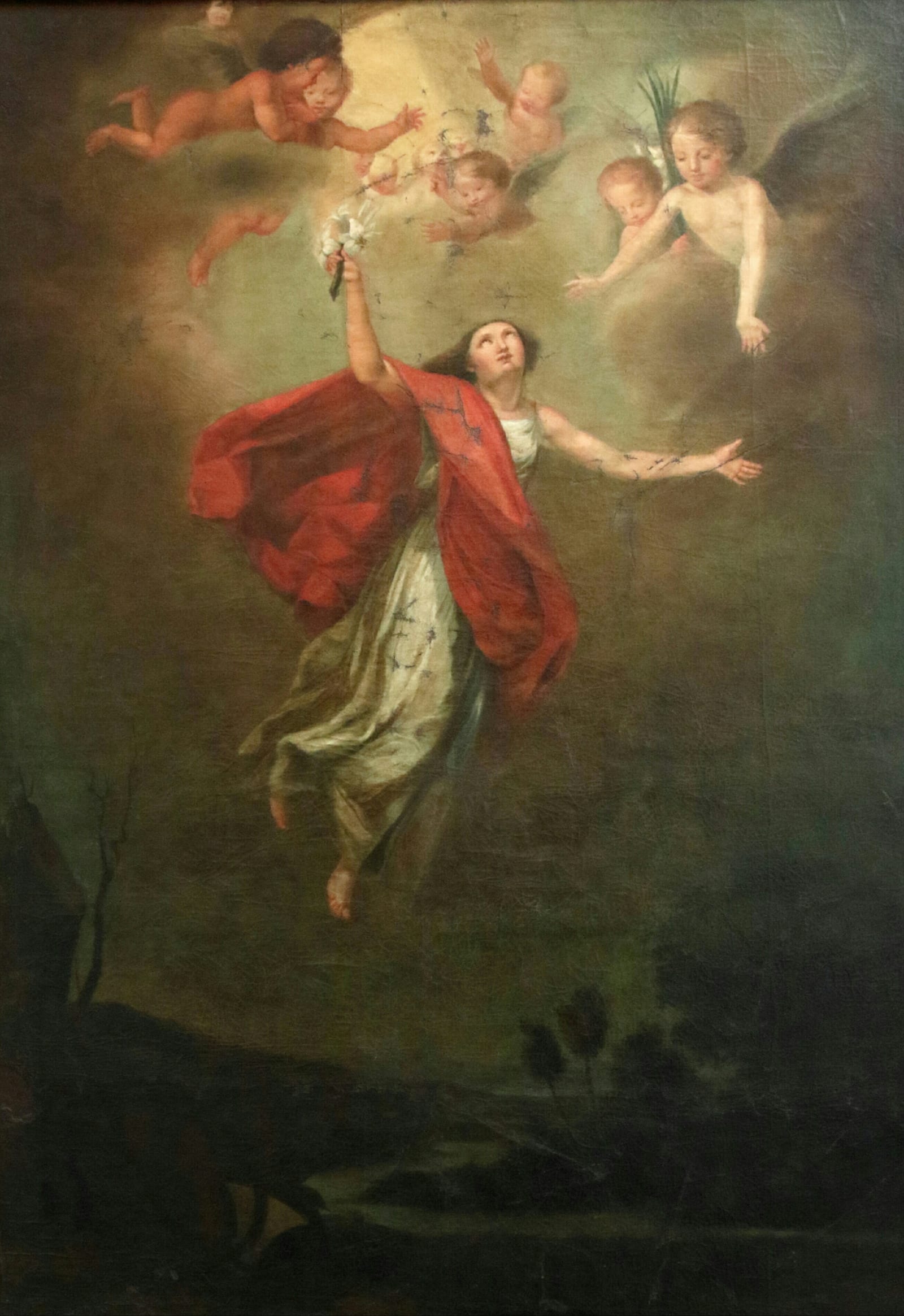
On May 24, 1802, excavators in the Catacomb of Priscilla at Rome opened a loculus sealed with three terracotta tiles painted with lilies, arrows, an anchor, and a palm, and lettered LUMENA PAX TE CUM FI — read, rearranged, as Pax tecum Filumena: 'Peace be with thee, Philomena.' Inside lay the bones of a girl of about thirteen and a vial of the kind then taken as a sign of martyrdom. Nothing else — no acts, no history — is known of her from antiquity.
In 1805 the relics were given to the priest Francesco De Lucia, who enshrined them in his village church at Mugnano del Cardinale, near Naples. Miracles began immediately and did not stop: cures of cancer and heart disease, multiplication of the bone dust distributed as relics, and above all the sensational 1835 healing of Pauline Jaricot, foundress of the Society for the Propagation of the Faith, whose grave heart disease vanished at the shrine before crowds — a cure investigated by Gregory XVI personally. Two years later he canonized Philomena, the only canonization in the Church's history resting purely on posthumous wonders.
Her greatest apostle was the Curé of Ars. St. John Vianney kept her relic at Ars, built her a chapel, and deflected every miracle attributed to himself onto her — 'my dear little saint,' his 'agent with God.' Sts. Peter Chanel, Peter Julian Eymard, Madeleine Sophie Barat, and Damien of Molokai were among her devotees; St. Bartolo Longo consecrated the Pompeii shrine works to her.
Shown for both sides, per the source policy: in 1961 the Sacred Congregation of Rites removed her feast from all calendars, after archaeologists argued the tiles had been reused and the loculus might not be a martyr's grave at all. Her devotees answer that the Church has never annulled the canonization nor suppressed the cult — the sanctuary at Mugnano operates with full approval, and archconfraternities in her honor continue worldwide. She remains the Church's strangest case: a saint known only by her bones, her name, and what heaven appears to have done through them.