
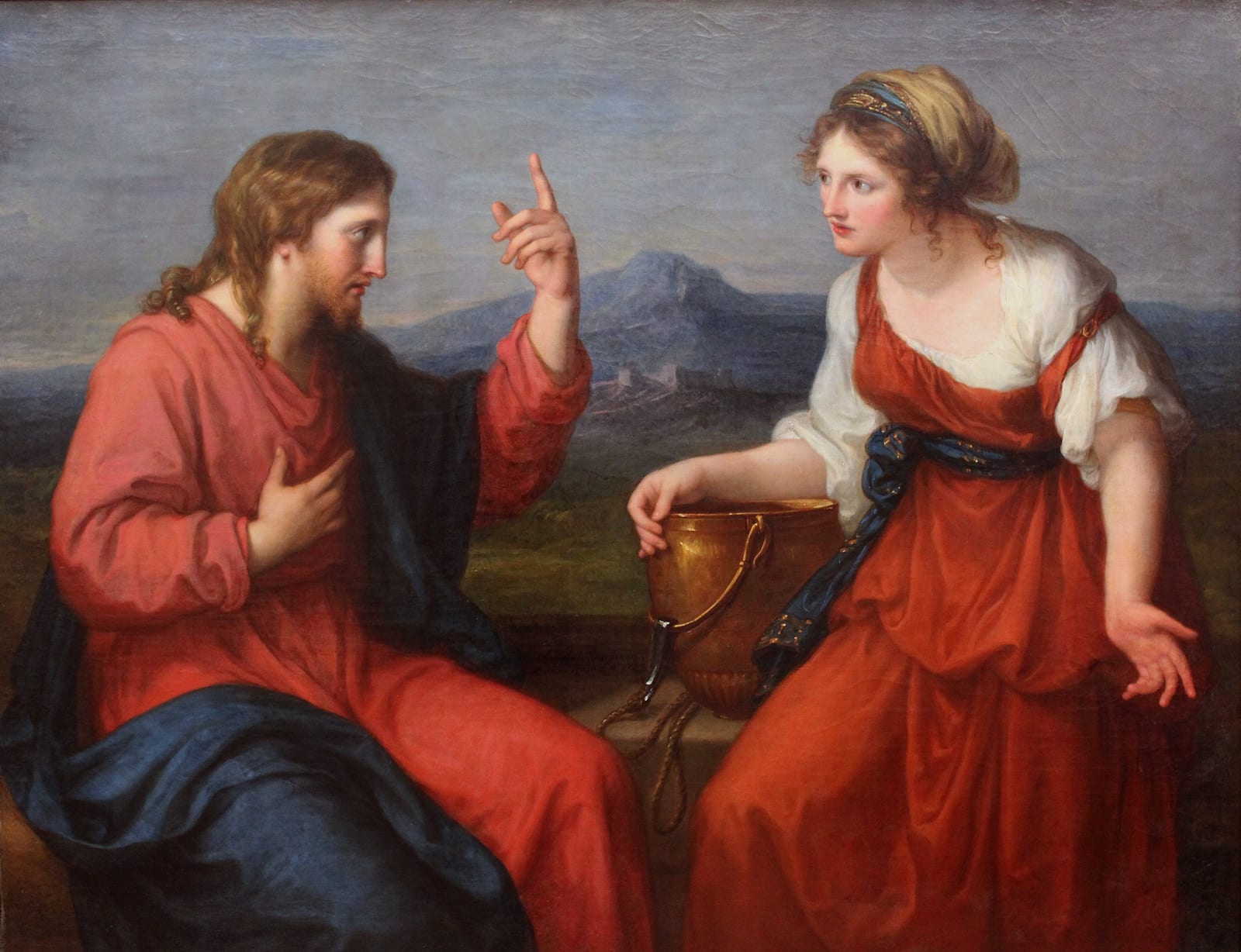
The Samaritan woman at Jacob's Well (John 4:4–42) — unnamed in the canonical Gospel — is identified by the universal Byzantine tradition with the name Photina (Greek Phōteinē, 'the luminous one,' from the Christian sense of her enlightenment by Christ). Her encounter with Christ at the well outside the Samaritan town of Sychar is one of the longest single Gospel dialogues with any individual and the foundational New Testament text on the universal extension of the Gospel beyond ethnic-religious boundaries (Samaritans were in continuous religious conflict with Jews of Christ's day).
She returned to Sychar after the encounter and brought the entire town out to meet Christ ('Come, see a man who told me all things whatsoever I have done. Is not he the Christ?' — John 4:29), with the result that 'many of the Samaritans of that city believed in him' (John 4:39). The episode makes her the first New Testament evangelist to a non-Jewish (Samaritan-pagan) community.
The Byzantine tradition holds that Photina, her two sons (Joseph and Victor), her five sisters (Anatolia, Photo, Photis, Paraskeve, and Kyriaki), and several other companions travelled to North Africa, then to Rome, and were martyred there during the persecution of Nero (c. AD 66) — Photina herself by being thrown into a well at Rome and left to drown. Her cult is particularly strong in the Byzantine Orthodox tradition, where the Fourth Sunday of Pascha is named the Sunday of the Samaritan Woman in her honour.