
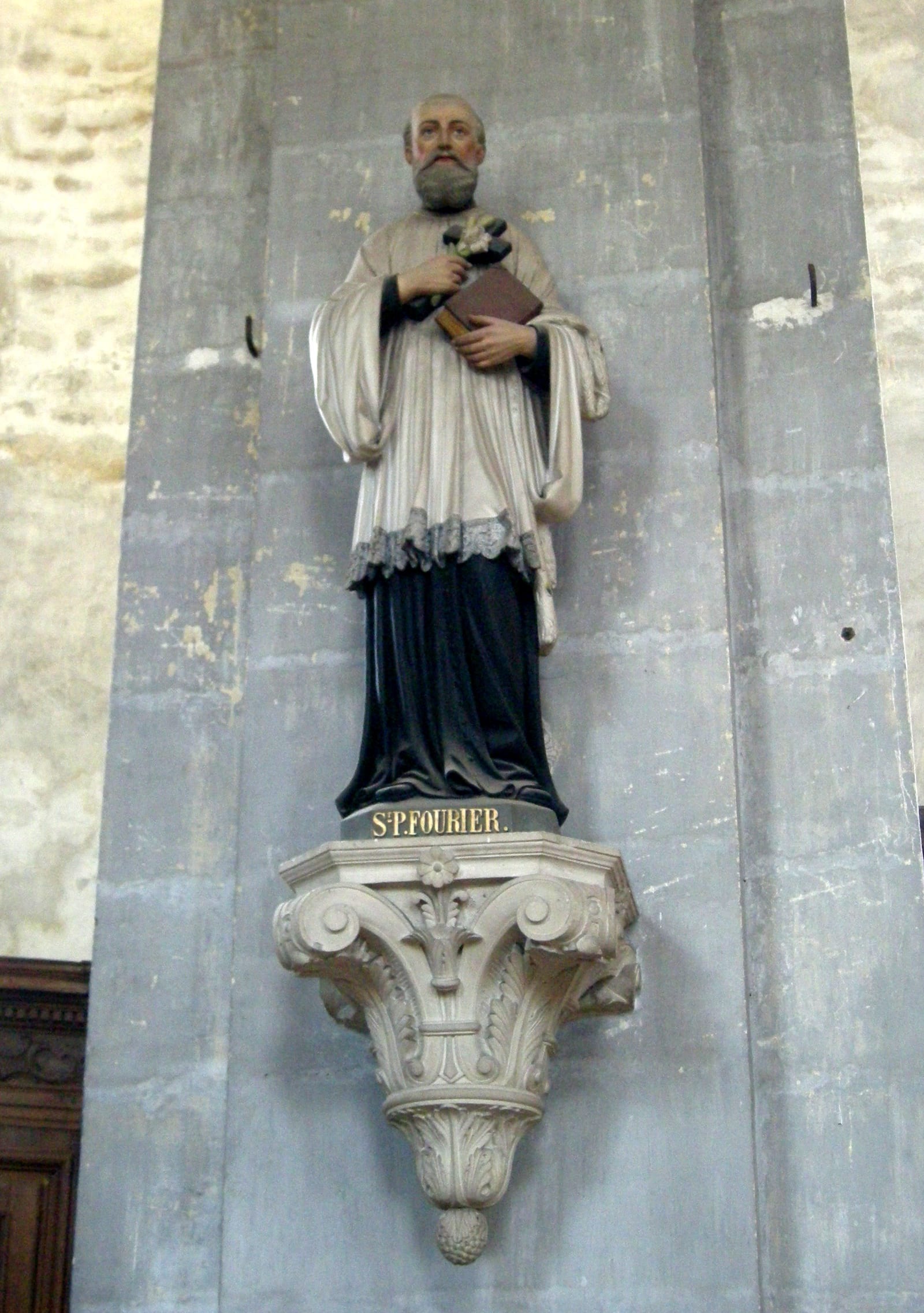
Pierre Fourier was educated by the Jesuits at Pont-à-Mousson, ordained priest in 1589, and entered the Canons Regular of St. Augustine at the abbey of Chaumousey near Épinal. He was assigned as parish priest to the small Lorraine village of Mattaincourt in 1597, where he remained for thirty-three years as a model rural pastor: organizing systematic catechesis, mediating Lorraine vendettas, and (during the Thirty Years' War years from 1618 onwards) operating Mattaincourt as a regional refugee centre.
His central institutional work was the founding — together with Bl. Alix Le Clerc — of the Augustinian Canonesses of Our Lady (Congregation of Notre-Dame), confirmed by Paul V in 1616. The new women's order was specifically dedicated to the free education of poor girls — a pastoral category to which most existing women's orders had paid little systematic attention. The Canonesses opened houses across Lorraine, Burgundy, and northern France; by Fourier's death they were running over forty schools and had become the first major Catholic women's teaching order dedicated specifically to girls' free education. (The slightly earlier Ursulines of Italy and France had developed into a paying-school institution; Fourier's Canonesses were specifically free for the poor.)
He died at Gray in Franche-Comté on December 9, 1640. Canonized 1897. He is the principal historical figure in the development of Catholic free schools for girls — the parallel for women's education to what Joseph Calasanz and the Piarists did for boys' education a generation earlier in Rome.