
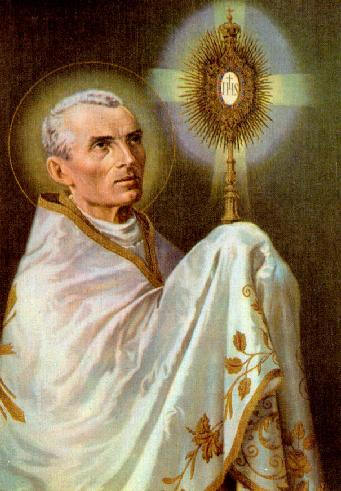
Pierre-Julien Eymard was the son of a small Dauphinois village carpenter at La Mure d'Isère. He was ordained priest in 1834 in the diocese of Grenoble, served briefly as parish priest, then in 1839 entered the new Society of Mary (the Marists, founded by Marcellin Champagnat's spiritual brother Jean-Claude Colin in 1816, formally confirmed by Pope Gregory XVI in 1836 — distinct from Champagnat's Marist Brothers). He spent sixteen years as a Marist — including a year (1851) as superior at the Marist national shrine of La Mure (Fourvière in Lyon).
From the early 1850s he received a series of personal mystical experiences that convinced him of his distinct vocation: the foundation of a new congregation dedicated specifically and exclusively to the public worship of the Holy Eucharist, the spread of Eucharistic devotion (especially Perpetual Adoration), and the catechetical preparation of adult Catholics — particularly the working-class urban poor — for systematic Communion. The Pope and his Marist superiors authorized his departure from the Marists in 1856.
On May 13, 1856, he founded the Congregation of the Most Blessed Sacrament (Société du Très-Saint-Sacrement, the Blessed Sacrament Fathers — the Eymardian Fathers) at the small Paris house on the Rue Diderot. The congregation was confirmed by Pius IX in 1863. Its specific apostolate — public exposed Eucharistic adoration combined with Catholic catechetical preparation of working-class adults for first Communion — was the immediate precursor of the great late-19th-century French Eucharistic revival, of the late-19th and early 20th-century International Eucharistic Congresses (the first held at Lille 1881, eighteen years after his death), and of the perpetual adoration practice that spread across the Catholic world after Vatican II. He died at his birthplace La Mure d'Isère on August 1, 1868. Canonized 1962 by John XXIII — the Pope who two years earlier had convoked the Second Vatican Council.