
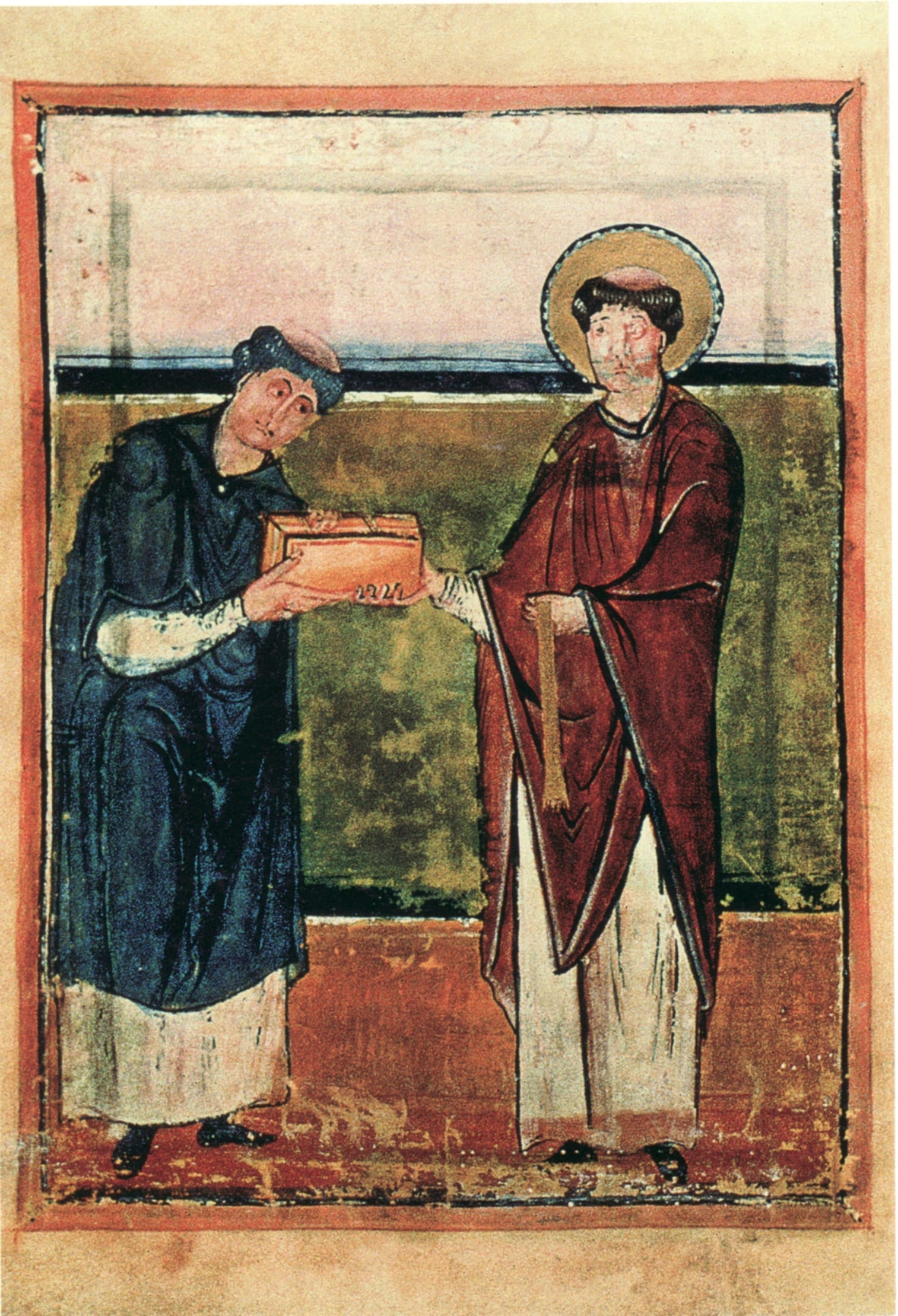
Pirmin's origins are obscure — possibly a Visigothic refugee from Muslim Spain, possibly a Frankish or Irish missionary. He emerges in the historical record around 724 founding the great Abbey of Reichenau on an island in Lake Constance — at the invitation of the Alemannic Duke Sintbert and with the approval of Charles Martel.
Reichenau became one of the most important monastic centers of the Carolingian world — a school of art (the great Reichenau manuscripts), of theology, of medicine, and of music. Its early library was among the most extensive in 8th-century Europe. The island of Reichenau is today a UNESCO World Heritage Site.
Driven from Reichenau in a political dispute, Pirmin spent his last decades founding further monasteries across Alemannia and the Palatinate — Murbach, Pfäfers, Hornbach, and others. He died at Hornbach in 753. His treatise Dicta Pirminii (the 'Scarapsus') is the earliest surviving Latin manual of Christian doctrine and morals composed for ordinary laypeople — the seedbed of medieval catechetical writing.