
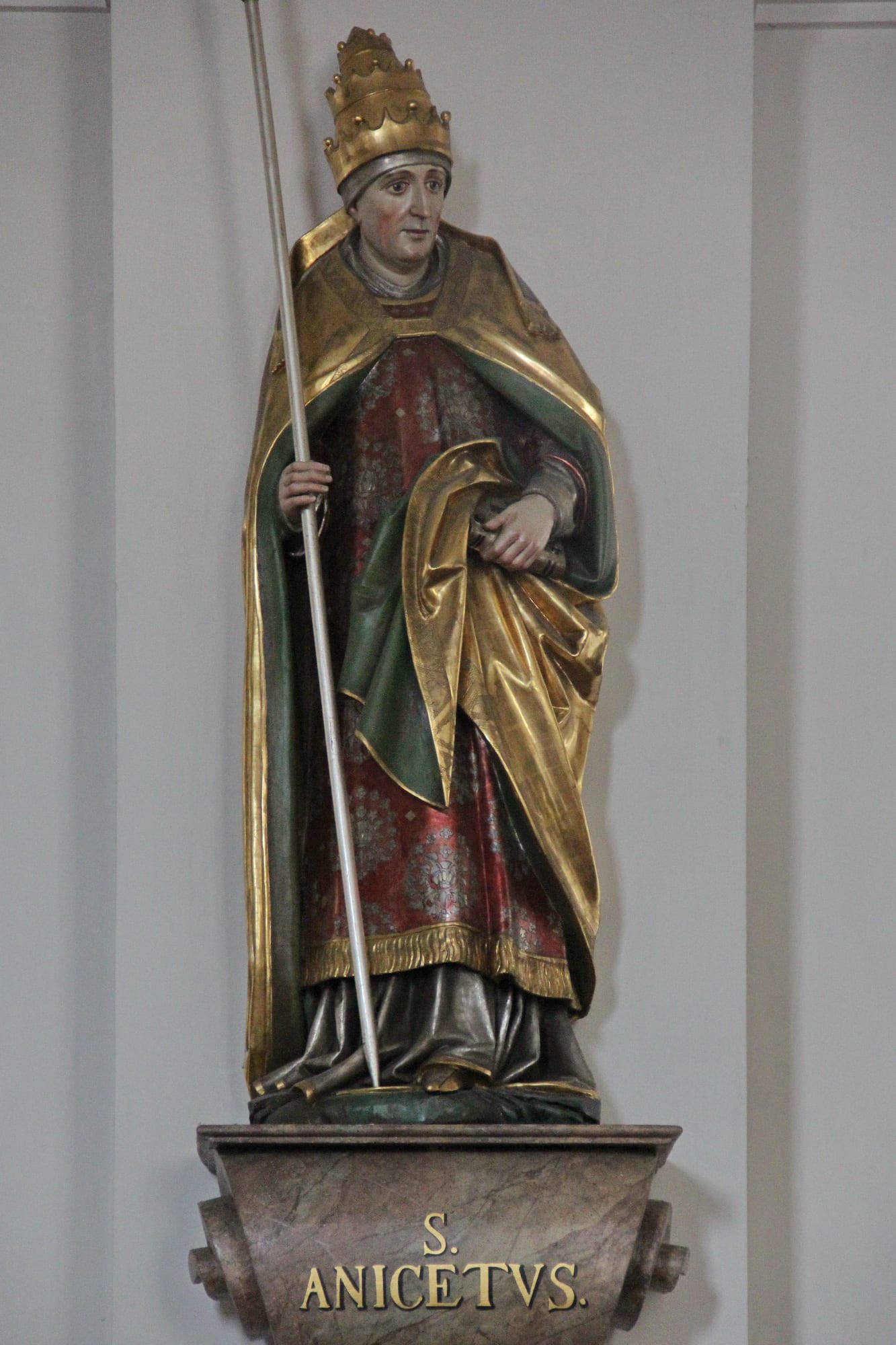
Anicetus (Greek Aniketos, 'invincible') was a Syrian by birth, per the Liber Pontificalis. His twelve-year pontificate (c. 155–167) was particularly important for two reasons.
First, around AD 155 the aged Polycarp of Smyrna (see his entry in the 2nd-c. catalogue) made his famous visit to Rome to discuss with Anicetus the long-disputed question of the date of Easter — the so-called Quartodeciman controversy. The Asian Christian tradition, which Polycarp represented, kept the Christian Pasch on the 14th day of the Jewish month of Nisan (the date of the Passover) regardless of the day of the week; the Roman tradition, which Anicetus represented, kept the Christian Pasch always on the Sunday following the Passover. The two old bishops met, discussed, and could not agree — but they parted in peace, with Anicetus inviting Polycarp to celebrate the Eucharist in the Roman papal chapel as a gesture of mutual recognition. The episode is preserved by Eusebius (Church History 5.24) as the foundational early Catholic example of ecumenical peace amid liturgical-disciplinary disagreement.
Second, Anicetus had to confront the major early gnostic teachers Marcion of Sinope (whose excommunication had occurred under his predecessor Pius I) and the Valentinian school then active in Rome. He also had to manage the persecution context of the early reign of Marcus Aurelius (the Marcionite split, the Apollinarian school, the rising Quartodeciman tensions, all reaching crisis intensity).