
MIRACULOUS MIRACLES™

Saint — Pope Benedict VIII

Pope Benedict VIII
c. 980 AD, Rome (the Tusculani noble family — the counts of Tusculum) — April 9, 1024 AD, Rome
143rd Pope (1012–1024); reformer pope ally of Emperor St. Henry II
St. Peter's Basilica, Rome — tomb in the Vatican grottoes, Vatican City
Feast
April 9 (local Roman cult)
Canonized
Pre-congregation (venerated locally as reformer pope)
Life

Benedict VIII — born Theophylact of Tusculum, son of Gregory I, Count of Tusculum — was one of the most consequential popes of the early 11th century. The Tusculani noble family of Latium produced three successive popes (Benedict VIII, John XIX, Benedict IX) — the Tusculan Papacy of the early 11th century.

He was elected pope on May 18, 1012, against the rival candidate of the Crescentii family. His twelve-year pontificate restored the dignity of the papal office after the depredations of the late-10th-century saeculum obscurum.

He allied with the Saxon-Salian Emperor St. Henry II — crowning Henry and his wife St. Cunigunde as Holy Roman Emperor and Empress at the basilica of St. Peter on Sunday February 14, 1014. The 1014 imperial coronation instituted the continuous tradition of Saxon-Salian and Hohenstaufen imperial coronations at Rome by the pope — the ritual pattern that would extend through the medieval centuries.

Most consequentially, at the 1014 imperial coronation, Benedict VIII — at the request of Emperor Henry II — for the first time permitted the singing of the Nicene Creed with the Filioque clause ('and the Son') at the Mass in Rome. The Filioque addition — previously practised in the Frankish and German Catholic Churches but not at Rome — became the permanent Roman Mass practice from 1014, precipitating the doctrinal escalation that would contribute to the definitive East-West Schism of 1054.

He convened the Synod of Pavia (1022) — the principal reform synod of his pontificate, addressing the scandals of clerical concubinage and simony, anticipating the Gregorian Reform of the mid-11th century.

He negotiated the Roman naval cooperation with the rising Norman power in southern Italy — supporting the Norman knight Melus's early-Norman campaigns in Apulia against the Byzantine Catepanate, the distant institutional pre-history of the Norman conquest of southern Italy that would culminate in the Norman Kingdom of Sicily.

He died on April 9, 1024.

Miracles & Phenomena
  • The 1014 introduction of the Filioque into the Roman Mass

    Benedict VIII's permission at the February 14, 1014 imperial coronation of Henry II for the singing of the Nicene Creed with the Filioque clause ('and the Son') at the Roman Mass — at the request of Emperor Henry II, introducing the long-standing Frankish-German practice into the Roman liturgy for the first time — became the permanent Roman Mass practice from 1014 and precipitated the Catholic-Orthodox doctrinal escalation that would contribute to the definitive East-West Schism of 1054. The Roman Filioque has remained the standard Latin Catholic practice to the present day; the Eastern Orthodox tradition (and the Eastern Catholic Churches in varying degrees) continue to object to the Roman insertion.

  • The reform synod of Pavia (1022)

    Benedict VIII's convocation of the Synod of Pavia in 1022 — addressing the scandals of clerical concubinage, simony, and the hereditary transmission of ecclesiastical benefices — anticipated the Gregorian Reform of the mid-11th century. The Pavia canons established the disciplinary framework that the Popes Leo IX, Nicholas II, and Gregory VII would institutionally elaborate into the Gregorian Reform proper.

Relics
  • Body
    Tomb of Pope Benedict VIII
    Vatican grottoes, St. Peter's Basilica, Rome

    Buried in St. Peter's; remains in the Vatican necropolis.

Iconography
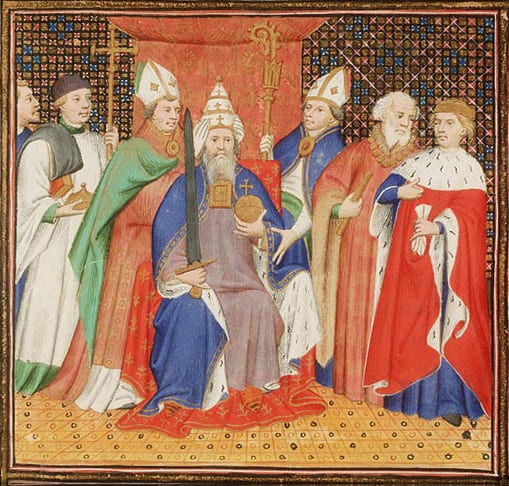
  • Benedict VIII crowning Henry II at the 1014 coronation

    The early-11th-century Roman pope in papal vestments at the basilica of St. Peter's on Sunday February 14, 1014 placing the imperial crown on the kneeling Saxon-Salian Emperor Henry II, with Empress Cunigunde awaiting her coronation beside him, the congregation singing the Nicene Creed with the newly-introduced Filioque clause — the iconography of Catholic Imperial-papal alliance tradition.

Patronages
Catholic Imperial-papal reform tradition (with Emperor St. Henry II)Catholic Filioque-affirmation tradition (the 1014 introduction of the Filioque into the Roman Mass)