
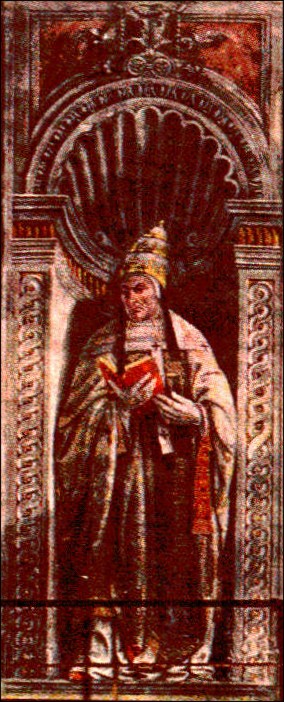
Dionysius was elected Bishop of Rome on July 22, 259 — after the see had been vacant for nearly a year following the martyrdom of his predecessor Sixtus II under the Valerian persecution of August 258 (see Sixtus II's entry already in the catalogue). The Roman Church had been severely persecuted: Sixtus II was beheaded at the Catacombs of San Callisto during a Mass; Lawrence the Deacon was grilled to death three days later (see his entry already in the catalogue); the bulk of the Roman clergy had been killed or sent to forced-labor camps.
Dionysius's nine-year pontificate was principally devoted to the reconstruction of the Roman Catholic community after the persecution. The Edict of Gallienus of 260 — which ended the Valerian persecution and restored to the Catholic Church the legal right to assemble, to own property, and to use its cemeteries — provided the legal opening; Dionysius's organizational work used the opening to systematically restore the Roman parishes (the 25 tituli of the city), to formally establish the territorial-diocese pattern across the Italian provincial churches, and to write to the Patriarch Dionysius of Alexandria (see his entry above) addressing the foundational Trinitarian-theological controversy of subordinationism that had emerged from contemporary Alexandrian theology.
Dionysius's letter to his Alexandrian namesake — preserved partially by Athanasius (4th c.) — is the foundational early Roman intervention on Trinitarian doctrine, condemning both Sabellian modalism (which collapses the three Persons of the Trinity) and subordinationist tritheism (which fragments them). The foundational position established by Dionysius's letter would be vindicated at the Council of Nicaea in 325. He died on December 26, 268, the first peacefully-dying pope in over three decades.