
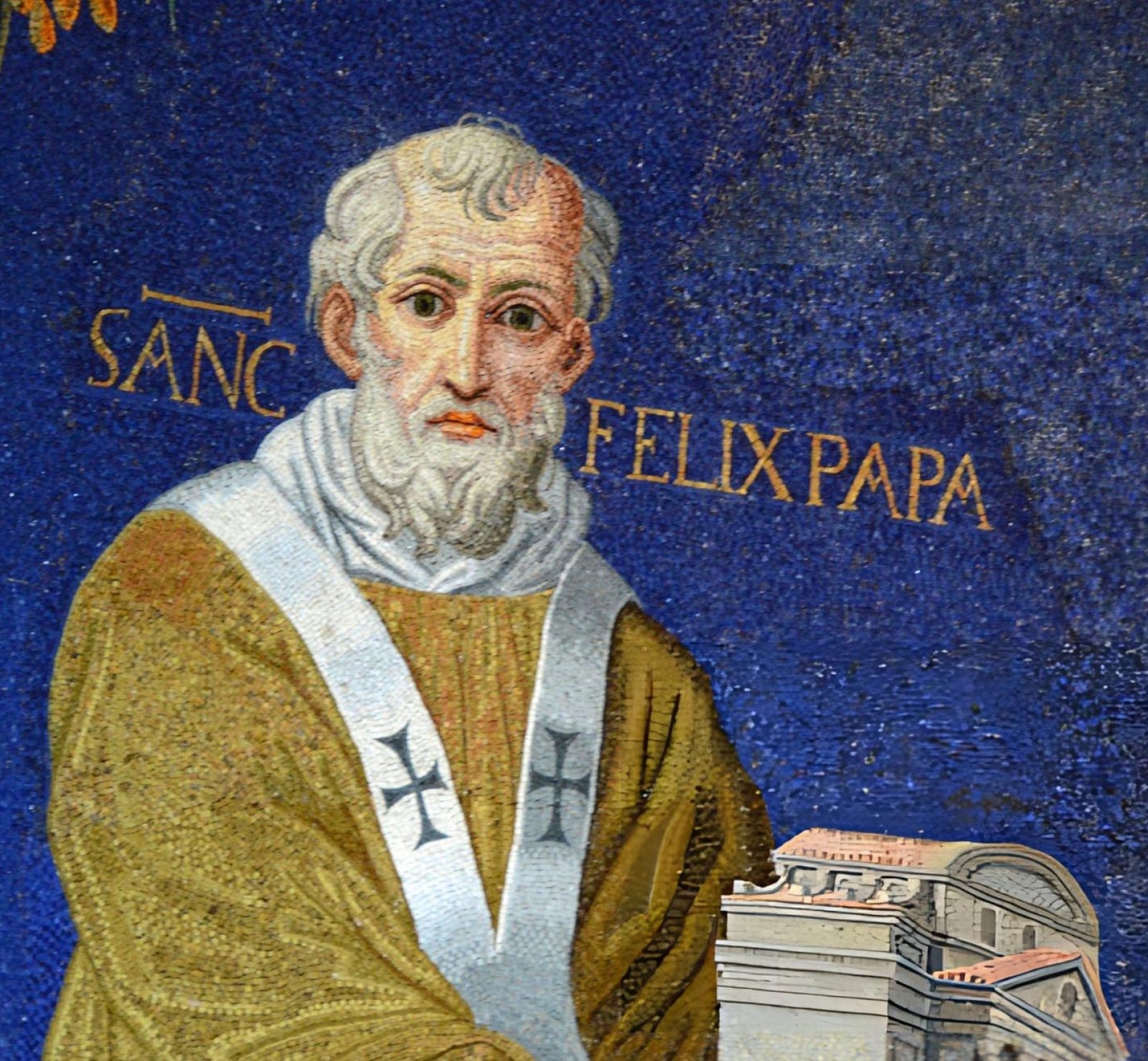
Felix IV (Latin Felix; the regnal-number IV reflects the medieval Catholic enumeration — Felix III of the Acacian Schism era is sometimes counted as Felix II if the brief antipope Felix II of 355–365 is not counted) was a Beneventine who succeeded John I as Bishop of Rome on July 12, 526. He was the personal choice of King Theodoric the Great (who had imposed his election against the wishes of the Roman clergy after Theodoric had had John I imprisoned).
His brief four-year pontificate is principally significant for two foundational contributions. First, the substantial architectural project at the Roman Forum: Felix obtained from Theodoric's daughter Amalasuntha (acting as regent for the young King Athalaric) the gift of the Templum Romuli (the small 4th-century imperial temple built by Maxentius on the Sacred Way as a memorial to his deceased son Romulus, adjacent to the great Basilica of Maxentius). Felix converted the Templum Romuli into the new Roman Catholic basilica of Santi Cosma e Damiano (dedicated to the Catholic medical-saint twins; see Cosmas and Damian's entry already in the catalogue). The basilica preserves substantially intact the foundational 6th-century apse mosaic — one of the supreme surviving early-medieval Roman mosaic works and the principal physical monument of Felix IV's pontificate.
Second, the foundational doctrinal contribution: the so-called Capitula Felicis IV (a set of doctrinal propositions on grace and predestination, composed by Felix in the last weeks of his life and intended to be submitted to a council, but never formally promulgated). These propositions were eventually incorporated into the canons of the Council of Orange of 529 (the foundational anti-Semi-Pelagian regional council convened in southern Gaul by Caesarius of Arles, see Caesarius's entry already in the catalogue) — establishing the Augustinian-Catholic doctrine on grace and predestination that remained the standard teaching of the Latin Church until the Council of Trent.
He died at Rome on September 22, 530. On his deathbed he attempted to designate his own successor (an unprecedented papal action that produced a substantial controversy after his death), naming the archdeacon Boniface (the future Pope Boniface II — see his entry below).