
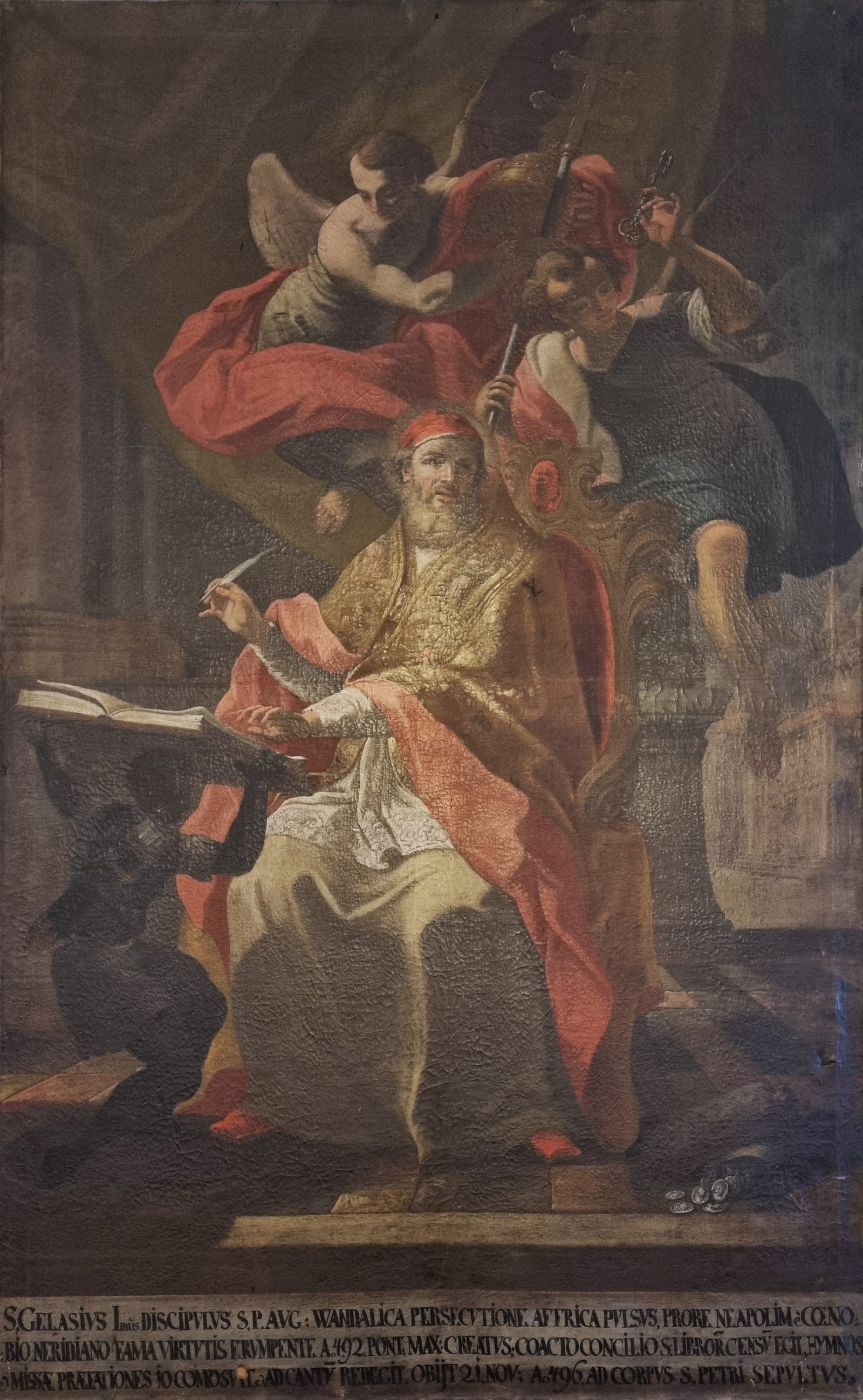
Gelasius I (Latin Gelasius) was — per the Liber Pontificalis — of Roman-African Berber descent, though he had been born and raised in Rome. He succeeded Felix III as Bishop of Rome on March 1, 492. His four-year pontificate is important for two interventions.
First, the famous Two Powers doctrine. In 494 AD, in his celebrated letter Famuli vestrae pietatis to the Eastern Emperor Anastasius I (one of the most important political-theological documents of the entire patristic period), Gelasius formulated the Catholic doctrine of the relationship between the spiritual authority of the Church and the temporal authority of the state: 'Duo sunt, imperator auguste, quibus principaliter mundus hic regitur: auctoritas sacrata pontificum et regalis potestas' ('Two there are, august emperor, by which this world is principally ruled: the sacred authority of the pontiffs and the royal power'). Gelasius then argues that the spiritual authority — because it must render account to God for the king himself — has, in spiritual matters, the higher dignity. The Two Powers formula became the Latin Western theological text for the entire medieval Investiture Controversy and for all Catholic political theology.
Second, the Roman papal liturgical-sacramentary work. The famous Sacramentarium Gelasianum (the 'Old Gelasian Sacramentary' — the earliest surviving manuscript form is from c. 750, but the compilation derives from Gelasius's pontificate) is one of the Catholic Latin liturgical books, transmitting in substantial detail the Roman-papal liturgical tradition of the late 5th century. The Sacramentary preserves the Roman liturgical-prayer tradition that eventually merged with the Gregorian Sacramentary tradition (c. 600) to form the shape of the medieval Roman Rite.
Gelasius also issued in 494 the famous Decretum Gelasianum (the 'Gelasian Decree') — an early-Catholic canonical list distinguishing canonical from non-canonical Christian writings. The list is one of the early-Catholic biblical-canonical documents and was substantially influential on the medieval Catholic biblical-canonical tradition.
He died at Rome on November 21, 496 AD. He is buried at St. Peter's Basilica.