
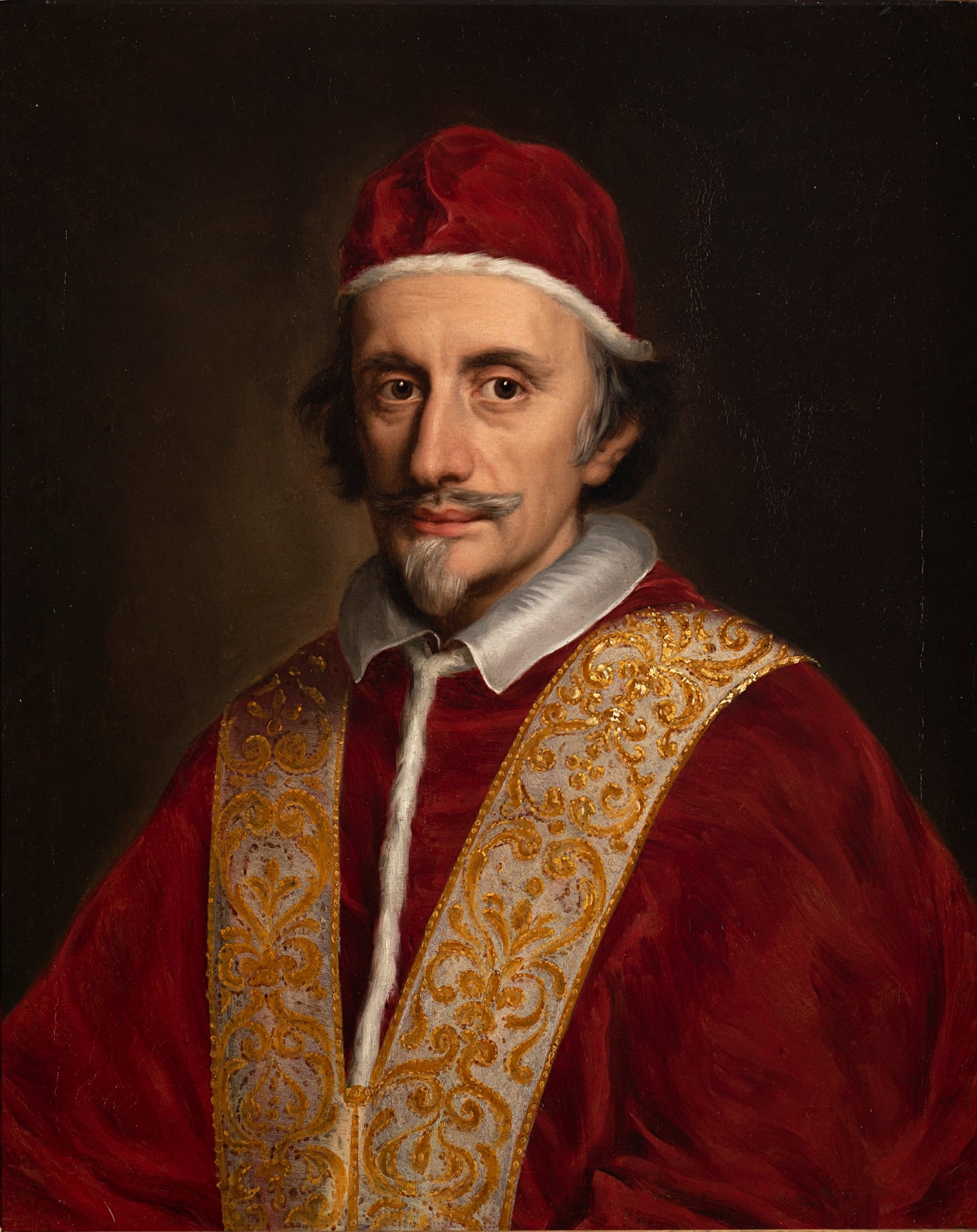
Benedetto Odescalchi was born to a great Como banking family, educated in canon and civil law at Rome and Naples, served twenty years in the curial administration, and was elected pope in 1676 against the determined French opposition led by Louis XIV. The conclave lasted two months; Odescalchi was the compromise candidate accepted only when no curial faction could win.
His thirteen-year pontificate was a relentless reform: cutting curial expenditures by two-thirds, suspending favours and pensions for cardinal-nephews (he refused to make his own nephew Livio a cardinal until repeatedly pressed by the College, then made him a minor cardinal with no political power), establishing rigorous standards for episcopal candidates, and personally examining hundreds of petitions for ecclesiastical office. He confronted Louis XIV directly over the long Gallican controversy and the 1682 Declaration of the French clergy.
His most consequential single act was the organization of the Holy League of 1684 — the coalition of the Papal States, the Habsburg Empire, the Polish-Lithuanian Commonwealth (Jan Sobieski), and Venice — that responded to the Ottoman siege of Vienna in 1683. Innocent XI personally directed the diplomatic and financial coordination that made the relief of Vienna possible. The Battle of the Kahlenberg outside Vienna on September 12, 1683 (the feast of the Holy Name of Mary) — where Sobieski's hussars broke the Ottoman army — was understood across Catholic Europe as Innocent XI's victory. The Habsburg counter-offensive that followed permanently reversed the Ottoman tide in Europe.
He died at Rome on August 12, 1689. The cause for canonization was opened almost immediately but was blocked for centuries by the lingering Gallican controversies; he was finally beatified by Pius XII in 1956. His incorrupt body rests at St. Peter's.