
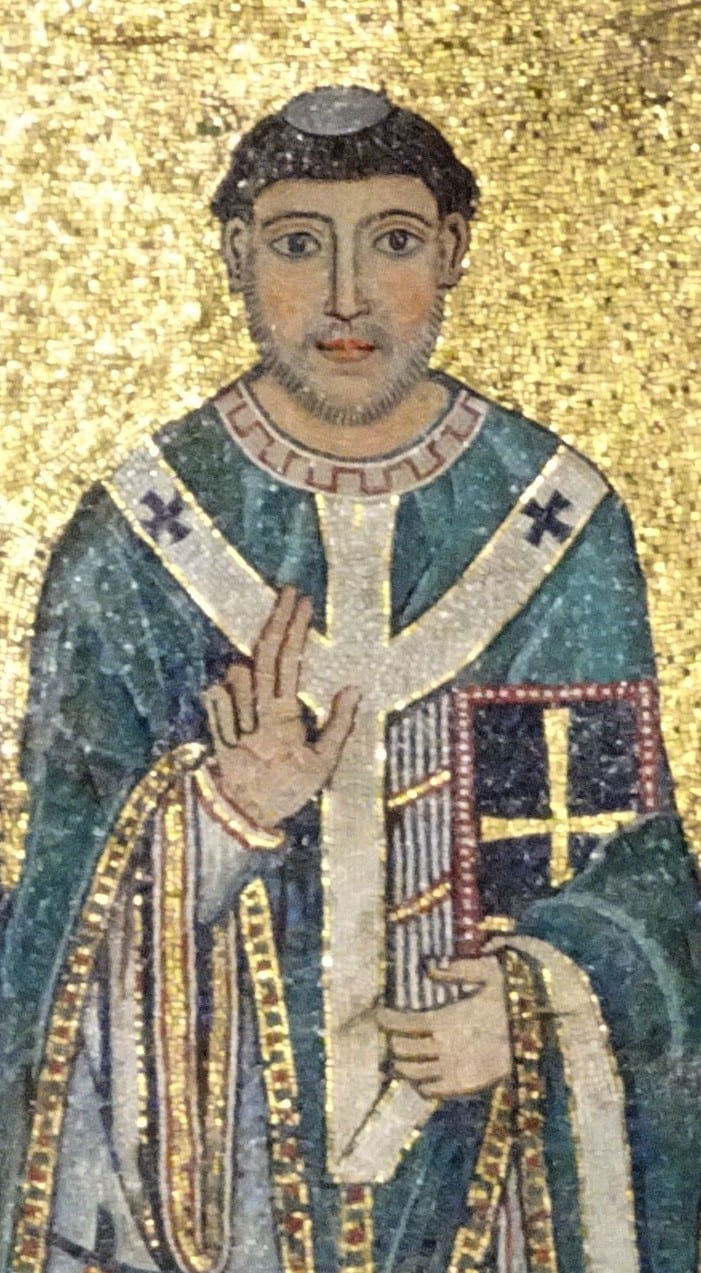
Julius I succeeded Mark as Bishop of Rome on February 6, 337 — just three months before the death of the Emperor Constantine the Great. His fifteen-year pontificate coincided with the catastrophic Arian crisis: the long imperial-supported Arian campaign against the Nicene Trinitarian orthodoxy of 325, led by Constantine's son Constantius II and supported by the Arian bishops Eusebius of Nicomedia, Acacius of Caesarea, and others.
Julius's principal historical role was as defender of Athanasius of Alexandria (see Athanasius's entry already in the catalogue) — the great Alexandrian Trinitarian patriarch repeatedly exiled by the Arian imperial party. When Athanasius arrived at Rome in 339 fleeing his second exile, Julius gave him formal asylum at the Lateran Palace and at the papal residence-complex. Julius then convoked at Rome in 340 a major synod that examined the Arian charges against Athanasius, found them to be false, and formally restored Athanasius to communion. The synod's decisions were ignored by the Eastern Arian bishops, but the foundational Roman papal precedent of judging conciliar decisions from other patriarchates was firmly established.
Julius then convened — with the support of the Western Emperor Constans (Constantius's brother) — the great Council of Sardica (modern Sofia, Bulgaria) of 343, which gathered some 300 Western bishops and 90 Eastern bishops. The Eastern Arian bishops walked out almost immediately; the remaining Western bishops formally vindicated Athanasius, condemned the principal Arian leaders, and (most foundationally) established the formal canonical procedure for the Roman papal appellate jurisdiction over other patriarchates: any bishop deposed in his home synod could appeal directly to the Bishop of Rome, who could then convene a new synod to re-examine the case (Canon 3 of Sardica, the foundational text of the Roman primacy in canonical jurisdiction).
Julius is buried at his original titular church of Santa Maria in Trastevere — the great early Roman basilica that, per medieval Roman tradition, had been founded by him on the site of the Taberna Meritoria (the small Roman tavern near the Tiber where, per the 4th-century tradition, a miraculous oil-fountain had appeared on the night of Christ's nativity in Bethlehem, signalling to pagan Rome the birth of the Saviour).