
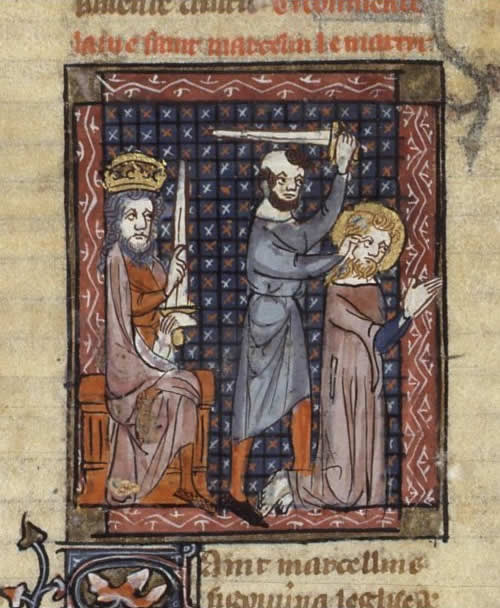
Marcellinus succeeded Caius as Bishop of Rome on June 30, 296. His eight-year pontificate began under conditions of relative peace and ended in the catastrophic first phase of the Great Diocletianic Persecution (which opened with Diocletian's edicts of February 303). He is one of the most historically-debated early Roman popes — partly because the contemporary documentation is uniquely scarce (the Great Persecution destroyed much of the Roman papal archive), and partly because a strong but contested tradition holds that he yielded under the persecution and offered pagan sacrifice — only to repent publicly soon after, undergo public penance, and die a confessor.
The traditional account — preserved in the Liber Pontificalis and elaborated by the legendary Council of Sinuessa narrative — holds that under Diocletian's persecution Marcellinus was arrested, was compelled to offer a brief pagan-sacrificial gesture (the standard libellus performance of the era), then within days repented publicly, returned to govern the Roman Church, denounced his own act before the assembled Roman clergy, asked to be deposed from the papacy, and was finally martyred at Rome on October 25, 304.
Modern critical scholarship has been divided on the historicity of the temporary lapse — Augustine of Hippo, writing a century later in the De Unico Baptismo against the Donatists, explicitly defended Marcellinus against the Donatist charge of apostasy (a defence which itself confirms that the charge was already circulating in the 4th century). The cult was continuous across the medieval period; the controversies were never decisive enough to remove him from the calendar. He was buried in the Catacombs of Priscilla per his own dying request — he refused burial in the Crypt of the Popes at San Callisto because (per the tradition) he judged himself unworthy after the lapse.