
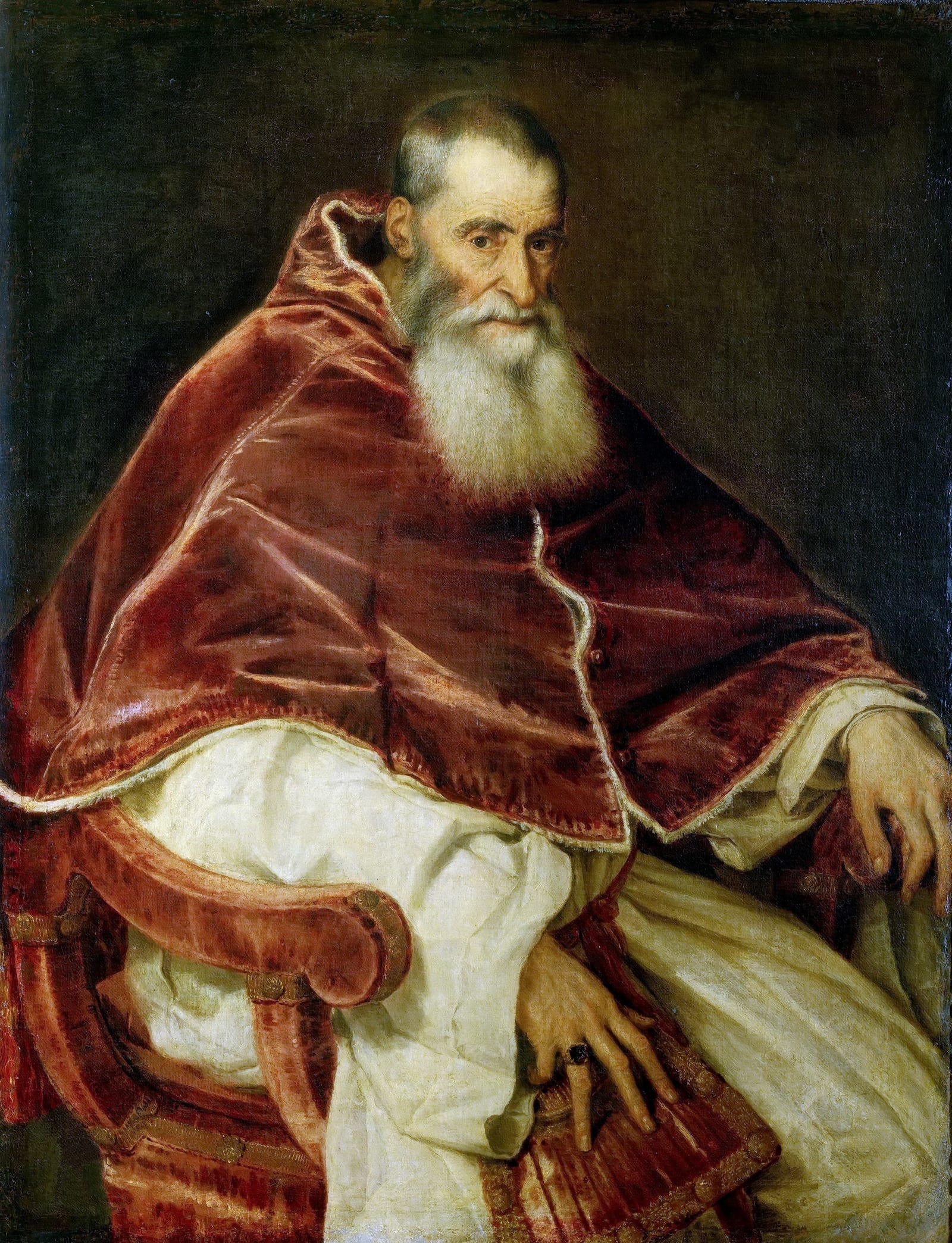
Alessandro Farnese was born on February 29, 1468 at Canino to the noble Farnese family. His sister Giulia Farnese was the famous mistress of Pope Alexander VI (Rodrigo Borgia) — the personal-political connection that accelerated Alessandro's ecclesiastical career.
Elected Pope on October 13, 1534, taking the name Paul III, his fifteen-year pontificate is the institutional-reforming turning-point of the 16th-century Catholic Church.
Paul III's three principal institutional accomplishments:
1. The Council of Trent (1545) — convoked by the papal bull *Laetare Jerusalem* (November 19, 1544) — opened at Trent on December 13, 1545 (continuing under Paul III's successors through the 1563 conclusion under Pius IV). The Council of Trent became the principal institutional response to the Protestant Reformation, defining the Catholic doctrines of justification, the sacraments, the Eucharist, purgatory, the Bible-and-tradition question, and instituting the Catholic Reform.
2. The approval of the Society of Jesus — by the papal bull *Regimini Militantis Ecclesiae* (September 27, 1540), approving Ignatius Loyola's Society of Jesus.
3. The approval of the Ursulines (1544, St. Angela Merici's women's teaching order), the Barnabites (1533), the Somaschans (1540, St. Jerome Emiliani's orphan-care order), and the Theatines' renewal.
Paul III also established the Roman Inquisition by the bull *Licet ab initio* (July 21, 1542) — the institutional predecessor of the Congregation for the Doctrine of the Faith.
He commissioned Michelangelo to paint the Last Judgment on the Sistine Chapel altar wall (1536–1541) — one of the principal Renaissance masterpieces.
He died at Rome on November 10, 1549.