
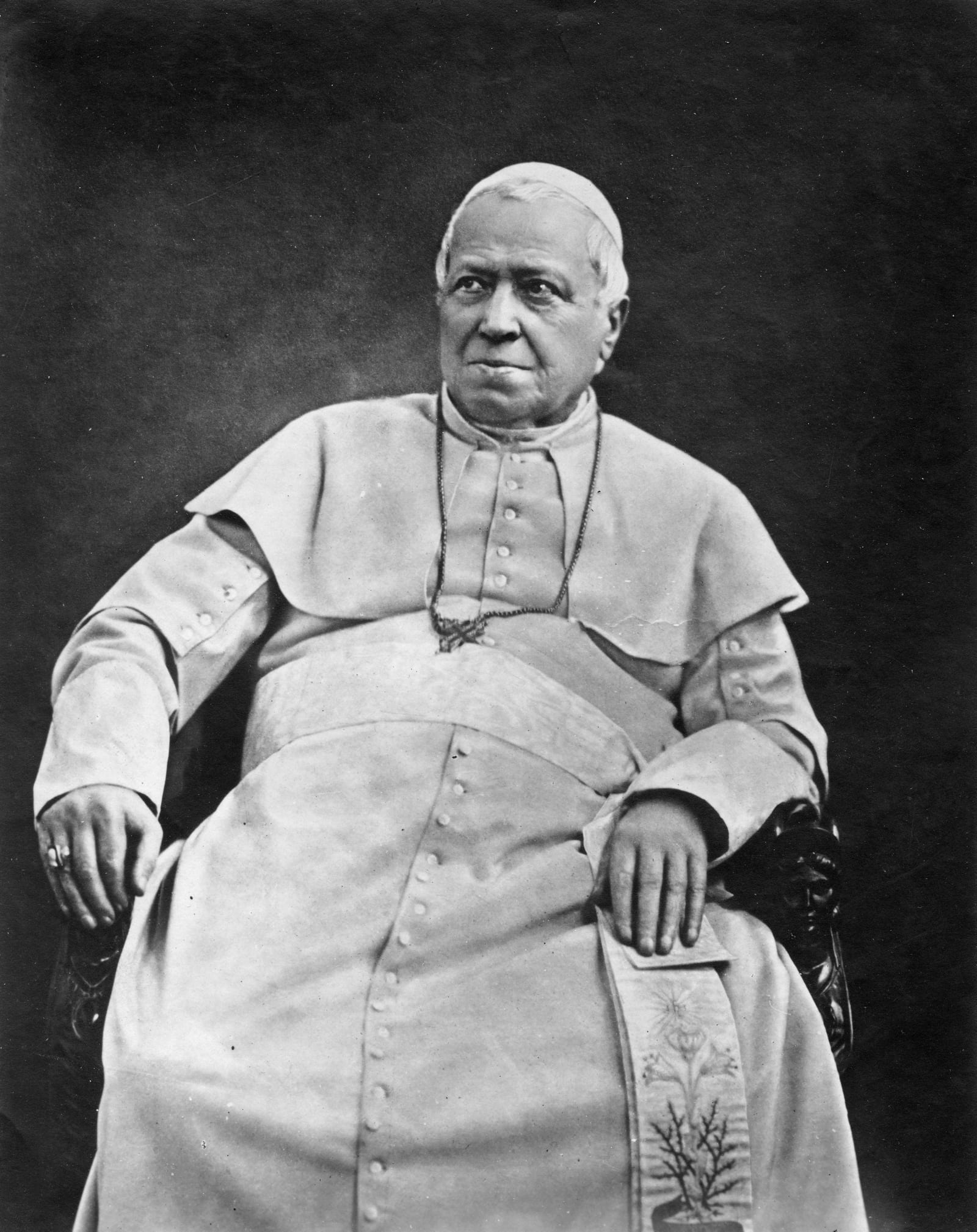
Giovanni Maria Mastai-Ferretti was born to a Marchigian noble family at Senigallia on the Adriatic, ordained priest in 1819, served as papal nuncio to Chile (1823–25), then as Archbishop of Spoleto (1827–32) and Bishop of Imola (1832–46). Elected pope at fifty-four on June 16, 1846 — the youngest pope of the 19th century — he was widely greeted across Europe as a reforming pope: he immediately granted political amnesty in the Papal States and proposed (in 1847) a moderate Italian-national customs union of the central Italian states.
The Roman Republic of 1848–49 — when Mazzini and Garibaldi briefly seized Rome and forced Pius into exile at Gaeta — permanently turned him against the Italian liberal-nationalist movement. The French restoration of papal authority in July 1849, and the long bitter struggle over Italian unification, dominated his second decade. The Kingdom of Italy seized Romagna in 1860 and the Papal States outside Rome in 1860–61. Finally on September 20, 1870 — during the deliberations of the First Vatican Council — Italian troops broke through the walls of Rome at Porta Pia and ended the millennial Papal States. Pius regarded himself thereafter as 'the prisoner of the Vatican' and refused to leave the Vatican grounds, beginning the 59-year Roman Question that was only resolved by the Lateran Treaty of 1929.
His doctrinal pontificate was correspondingly assertive. On December 8, 1854, in the bull Ineffabilis Deus, he defined the dogma of the Immaculate Conception of the Blessed Virgin Mary — the first ex cathedra dogmatic definition since the post-Reformation period. Four years later, on March 25, 1858, the Virgin appeared at Lourdes to St. Bernadette Soubirous and confirmed the recently-defined dogma by giving her name in Bernadette's Pyrenean dialect as 'I am the Immaculate Conception' (see the Bernadette entry already in the catalogue). The First Vatican Council (1869–70) under his direction defined papal infallibility in the dogmatic constitution Pastor Aeternus on July 18, 1870 — sixty-three days before the fall of Rome. His Syllabus of Errors (1864) condemned 80 propositions of modern political-philosophical liberalism. Beatified by John Paul II in 2000. His 31-year pontificate is the longest verified in Catholic history.