
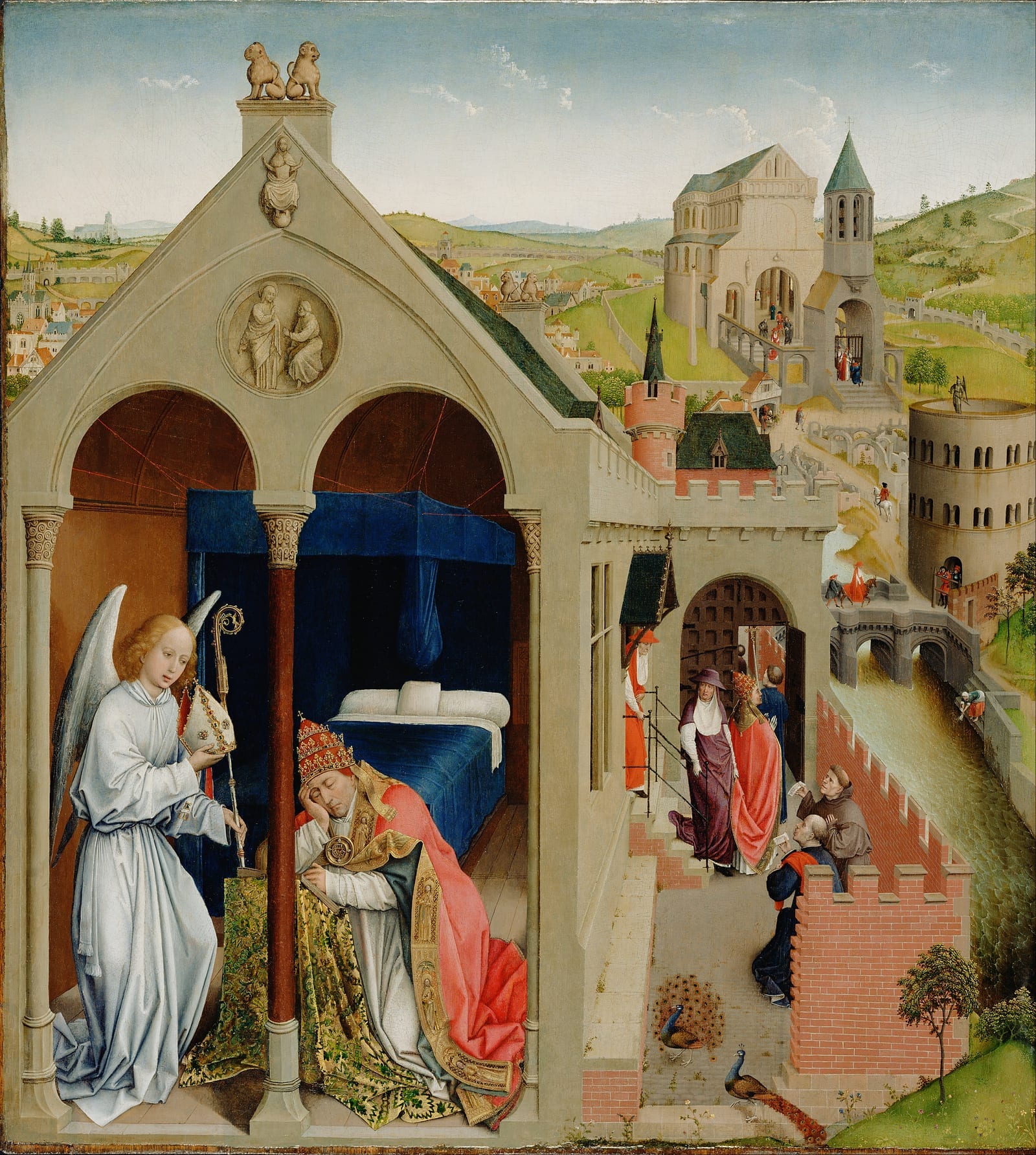
Sergius was the son of a Syrian Christian family that had fled the Muslim conquest of Antioch in the 630s and settled in Palermo. He came to Rome under Pope Adeodatus II, rose through the cardinal-presbyter ranks, and was elected pope in December 687 after a contested election that required imperial mediation between three candidates.
His pontificate is foundational for the Roman liturgy. He introduced the chanting of the Agnus Dei at the fraction of the Eucharist (an importation from his Greek-Syrian liturgical background, still in every Mass to this day), established the four great Marian feasts of the Roman calendar — Annunciation, Purification, Assumption, Nativity of Mary — with their proper liturgical processions, and reformed the procession from St. Adrian's to St. Mary Major on the feast of the Assumption.
He is most famous in church history for his refusal to ratify the Quinisext Council (Council in Trullo, 692) called by Emperor Justinian II. The council's canons on clerical marriage, Saturday fasting, and other disciplinary matters were judged by Sergius as contrary to Roman tradition. Justinian sent his protospatharius Zacharias to arrest Sergius and bring him to Constantinople — but the militia of Rome and Ravenna rose in the pope's defence, and Zacharias was reduced to hiding under Sergius's own bed before the pope intervened to save his life. The incident foreshadowed the eventual decisive papal-Byzantine break of the 8th century.
Sergius baptized King Cædwalla of Wessex at Easter 689 and consecrated Willibrord as Archbishop of the Frisians in 695 — directly launching the Anglo-Saxon mission to the Continent. He died on September 8, 701, and was buried in St. Peter's.