
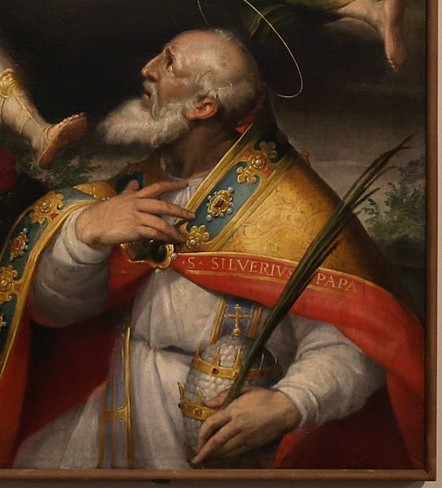
Silverius (Latin Silverius) was the son of Pope Hormisdas (see Hormisdas's entry above) — Hormisdas having been married before his ordination, and Silverius having been born before Hormisdas's clerical career. The father-son papal pair is one of only two clearly-documented in the entire history of the Catholic papacy (the other being Pope Anastasius II and Pope Innocent I, in the early 5th century).
Silverius's brief 17-month pontificate was the catastrophic foundational papal martyrdom-by-imperial-deposition of the Justinianic period. He was elected Bishop of Rome on June 8, 536 — during the Ostrogothic re-occupation of Rome after the death of Theodahad and the rise of the Gothic King Vitiges. When the Justinianic Byzantine general Belisarius captured Rome from the Goths on December 9, 536, the Empress Theodora — who was the patroness of the Monophysite faction in the Eastern Empire and was committed to the restoration of the deposed Constantinopolitan Patriarch Anthimus (see Agapitus I's entry above for the Anthimus deposition) — sent Belisarius secret instructions to depose Silverius and to replace him with the Roman deacon Vigilius (a Roman patrician who had served as papal apocrisiarius at Constantinople and had personally agreed to Theodora's terms in exchange for the papal support).
Belisarius arrested Silverius at the Lateran Palace on March 11, 537, on false charges of conspiring with the besieging Gothic forces. Silverius was forcibly deposed, reduced to monastic status, and exiled to the small Greek monastery of Patara on the southern coast of Asia Minor. Vigilius (see his entry below) was installed as pope in his place on March 29, 537.
The Emperor Justinian — when he eventually learned of the wholly-fabricated charges that had been used to depose Silverius — ordered him returned to Italy for proper trial. Vigilius and his Roman allies, however, had Silverius re-arrested as he disembarked at Italy, transported to the small uninhabited island of Palmaria (the modern Punta della Madonna, off the Italian coast between Naples and Rome), and there starved to death. He died on December 2, 537. The body was eventually translated to the small cathedral of Terracina in Lazio (the principal Catholic-civic centre near the Palmaria island), where it has remained the principal foundation of the Silverius cult since the medieval period.