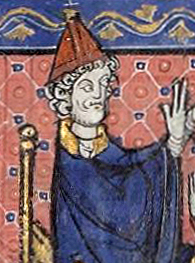
Stephen was a Roman, elected on 26 March 752 to succeed Zachary. He is Stephen II in the official list; older books call him Stephen III, because they counted a priest named Stephen who was elected in the same month and died before he could be consecrated — a pope-elect dropped from the list in 1961.
He inherited a crisis. In 751 the Lombard king Aistulf had taken Ravenna, the seat of the Byzantine exarch, and turned on the duchy of Rome. No help came from Constantinople. In October 753 Stephen left Rome with a Frankish escort, crossed the Alps in winter, and in January 754 met the Frankish king Pippin at Ponthion, beginning months of negotiation.
In April 754, at an assembly at Quierzy, the Frankish nobles agreed to a campaign in Italy, and Pippin set out in writing the territories he would win back for the pope rather than for the emperor — the promise known as the Donation of Pippin, the founding charter of the Papal States. In July 754, at the abbey of Saint-Denis, Stephen anointed Pippin, his queen and his sons, among them the future Charlemagne, and gave Pippin and his sons the title patricius Romanorum.
Pippin crossed into Italy in 755 and defeated Aistulf; when Aistulf broke his word, a second campaign in 756 defeated him again, and Pippin conferred on the pope the lands of the exarchate. The papacy's turn from Byzantium to the Franks — the hinge between the Byzantine and the Frankish centuries of the Roman Church — was Stephen's work. He died on 26 April 757 and was succeeded by his brother, St. Paul I.