
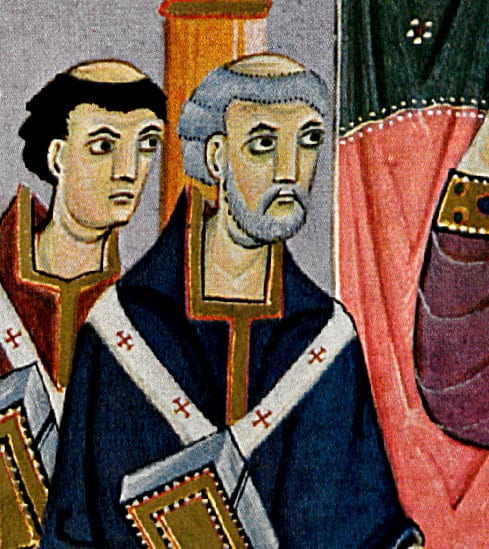
Gerbert of Aurillac — born around 946 to an obscure peasant family near Aurillac in Auvergne — was the most learned man of the Latin West in his lifetime. Educated at the Benedictine Abbey of Saint-Géraud at Aurillac, he was sent in 967 to Catalonia by Count Borrell II — where, at the frontier of Christian-Catholic and Islamic-Andalusian intellectual contact, he studied Arabic mathematics, astronomy, the astrolabe, and the Hindu-Arabic numerical system at the monasteries of Vic and Ripoll.
Returning north, Gerbert became director of the Reims cathedral school in 972 — the principal centre of Carolingian-Capetian Catholic learning — where he taught the quadrivium (arithmetic, geometry, astronomy, music) using the mathematical-astronomical knowledge he had absorbed in Catalonia. He introduced the abacus, the astrolabe, and the armillary sphere into the Latin Catholic intellectual tradition.
He became tutor to the young Emperor Otto III, Abbot of Bobbio (982), Archbishop of Reims (991–996), and Archbishop of Ravenna (998). On April 2, 999, with the support of Emperor Otto III, he was elected Pope — taking the name Sylvester II in deliberate reference to Pope St. Sylvester I (the pope of Constantine the Great's legalization of Christianity), announcing the programme of Catholic-imperial renewal under Otto III's 'Renovatio Imperii Romanorum'.
His four-year pontificate (999–1003) was devoted to the establishment of the new Catholic dioceses of Gniezno (Poland) and Esztergom (Hungary) — institutionally founding the Polish and Hungarian Catholic national churches that would underpin the thousand-year Catholic tradition of those nations. He crowned Stephen of Hungary as king (1000) and consecrated Boleslaw I of Poland as the Catholic royal patron of the Polish lands.
Sylvester II died on May 12, 1003. His reputation for learning — and the popular legend that he had made a pact with the devil to acquire his scientific knowledge — produced the medieval 'Pope-Magician' legend (a popular misunderstanding of his Arabic mathematical scholarship), but the scholarly Catholic tradition has recognized him as one of the greatest of the early-medieval Catholic intellectuals.