
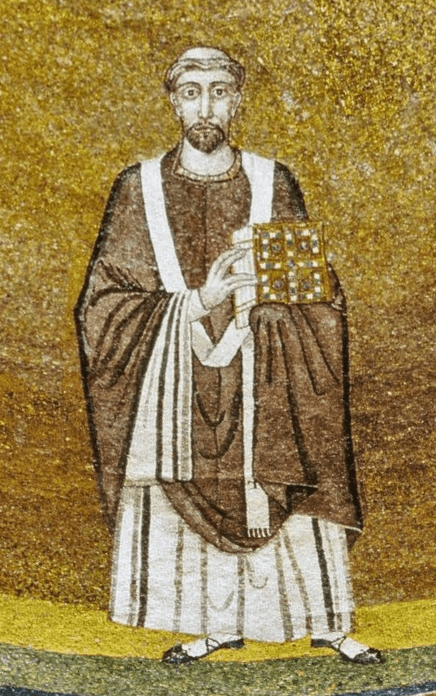
Symmachus (Latin Symmachus) was a Sardinian-born pagan convert to Christianity who had served at Rome as deacon before being elected Bishop of Rome on November 22, 498. His sixteen-year pontificate was dominated by the foundational Laurentian Schism — one of the most damaging contested papal elections of the entire patristic period.
On the same day as Symmachus's election by the majority faction of the Roman clergy at the Lateran, a minority faction elected the priest Laurentius pope at the Basilica of Santa Maria Maggiore. The dispute was forwarded to the Ostrogothic King Theodoric the Great at Ravenna (the Arian Ostrogothic king who governed Italy after Odoacer's deposition in 493). Theodoric — wisely — ruled in favour of whoever had been elected first and had the larger faction (which was Symmachus); Laurentius initially accepted the ruling.
The schism re-erupted in 501 when Laurentius's faction made fresh accusations against Symmachus (irregularities in his life and in his property administration). Theodoric summoned Symmachus to Ravenna for trial; Symmachus refused to appear (arguing — foundationally — that the Bishop of Rome could be judged only by the universal Catholic Church and not by a civil or by a lesser ecclesiastical tribunal). The Roman Synod of Palmaris of 502 — the famous synod held at the small church of Palmaris (Palms) near the Lateran — ruled that the pope was indeed not subject to civil-judicial jurisdiction and that the case against Symmachus should be dismissed. The principle established at the Palmaris Synod (Prima sedes a nemine iudicatur — 'the first see is judged by no one') became one of the foundational canons of medieval Catholic ecclesiology.
Despite the Palmaris ruling the schism continued in low intensity until 506. Symmachus, after the formal resolution, devoted his remaining years to the substantial architectural restoration of Rome — particularly the foundational rebuilding of the small church of St. Peter ad Vincula (the foundational Roman papal collection of the Chains of St. Peter, which had been translated to Rome from Constantinople around 442 by the Empress Eudoxia and which became the central focus of Symmachus's foundational architectural work). He died at Rome on July 19, 514.