
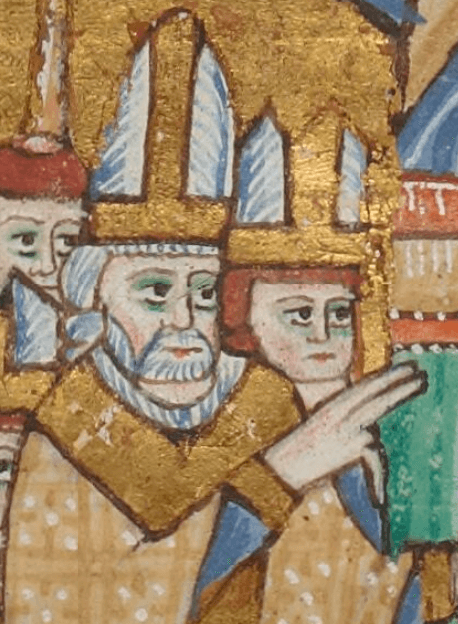
Odo of Châtillon — born around 1042 to a noble Champenois French family at Lagery — was educated at the cathedral school of Reims under St. Bruno of Cologne (the future founder of the Carthusian Order in 1084). Around 1070, he entered the Abbey of Cluny under Abbot St. Hugh of Cluny (the principal Cluniac abbot of the High Medieval period, abbot 1049–1109).
Pope Gregory VII summoned him to Rome around 1078 and created him Cardinal-Bishop of Ostia. He served as papal legate to Germany (1084–1085) during the Investiture Controversy.
After the brief pontificate of Bl. Victor III (Desiderius of Monte Cassino) of 1086–1087, Odo was elected Pope on March 12, 1088 at the Norman-controlled Terracina (Rome was still occupied by the antipope Clement III, Wibert of Ravenna), taking the name Urban II.
His eleven-year pontificate (1088–1099) consolidated the Gregorian Reform programme and undertook the systematic Catholic reform of the European clergy and monastic communities. He chaired the councils of Melfi (1089), Piacenza (March 1095), and Clermont (November 1095) — the principal late-11th-century reforming councils.
At the Council of Clermont on November 27, 1095, Urban II preached the sermon — to the assembled French Catholic episcopate and the French Catholic nobility and faithful — that launched the First Crusade. The sermon responded to the appeal of the Byzantine Emperor Alexios I Komnenos for military aid against the Seljuk Turkish advance, calling on the Catholic faithful of Western Europe to take up the Cross (accept the crusader's vow), travel to Jerusalem, and liberate the Holy Sepulchre from Muslim control. The famous response — 'Deus vult!' ('God wills it!') — of the assembled crowd at Clermont became the rallying-cry of the entire Crusader movement.
Urban II promised the complete indulgence of temporal sin to the Crusaders (one of the principal medieval institutional uses of the indulgence-tradition), instituted the Crusader sermon-and-vow procedure, and organized the diplomatic-logistical apparatus of the First Crusade.
The First Crusade departed in waves from France, Italy, Germany, and the Norman territories in August 1096 — and captured Jerusalem on July 15, 1099, after the three-year campaign. Urban II died fourteen days later on July 29, 1099, before the news of the Crusader capture of Jerusalem could reach Rome.
Beatified by Pope Leo XIII on July 14, 1881, Urban II is venerated as one of the principal medieval reforming popes and the principal historical-papal patron of the entire Crusading movement.