
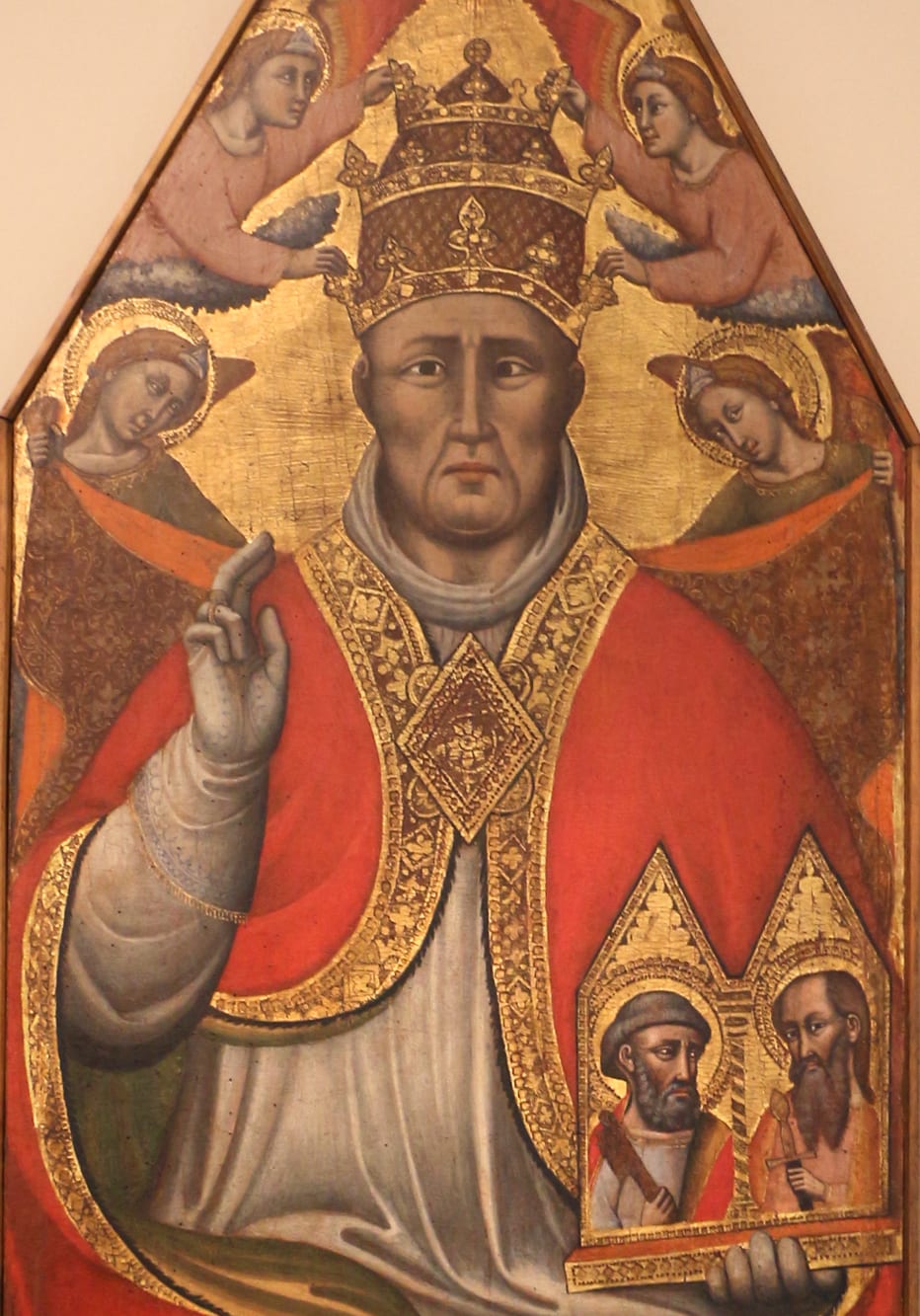
Guillaume de Grimoard was born to a noble Languedocian family, entered the Benedictines at Chirac as a child, and rose through legal and theological studies at Toulouse, Montpellier, Paris, and Avignon to become abbot of Saint-Victor of Marseille in 1361. The following year, while serving as papal legate in Naples, he was elected pope in absentia by the Avignon conclave — without ever having been a cardinal — and took the name Urban V.
His eight-year pontificate was the high reform-moment of the Avignon papacy. He sponsored fifteen hundred poor scholars at the universities of Paris, Bologna, Toulouse, and Montpellier (his accounts survive), founded the University of Vienna in 1365 and chartered the University of Cracow in 1364, restored the abbey of Saint-Victor as a major centre of learning, and personally returned to monastic discipline within the papal court — eating with the simplicity of his Benedictine training, wearing the habit, and continuing the canonical hours.
His central political act was the attempt to return the papacy from Avignon to Rome. He arrived in Rome on October 16, 1367 and remained for three years — the first pope to enter the city since 1305. Pressure from the French court and the impossibility of governing the Papal States from such a distance drove him back to Avignon in September 1370. He died at Avignon less than three months later. The full return to Rome was achieved by his successor Gregory XI at the urging of Catherine of Siena and Bridget of Sweden. Pius IX beatified him in 1870.