
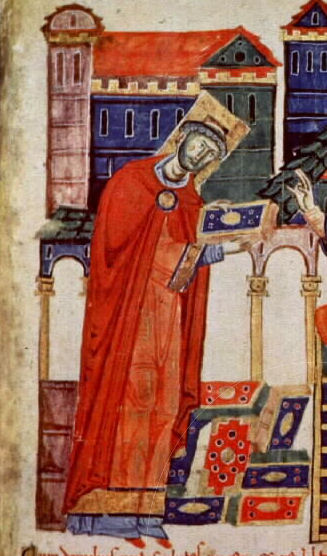
Desiderius — born 1027 to the noble Lombard family of Benevento — entered religious life as a young man, became a monk at the Abbey of Santa Sofia at Benevento, then migrated north to the Abbey of Monte Cassino (the mother-house of the Benedictine Order, founded by St. Benedict of Nursia c. 529).
In 1058 — at the age of 31 — Desiderius was elected Abbot of Monte Cassino, inheriting the governance of the principal Benedictine monastery of the Catholic West. His twenty-eight-year abbacy (1058–1086) is the golden age of Monte Cassino — the period of the greatest artistic, cultural, and political-ecclesiastical influence of the principal Benedictine monastery.
Desiderius rebuilt the abbey-church (consecrated 1071 by Pope Alexander II) — commissioning Byzantine artists from Constantinople to decorate the new church with mosaics, bronze doors (cast in Constantinople c. 1066, surviving in situ today), and Byzantine-Italian frescoes that became the principal Byzantine-Catholic artistic-exchange of the High Medieval period.
He allied with the rising Norman duchies of southern Italy (Robert Guiscard, Roger Borsa, Bohemond of Antioch) — cultivating the alliance that would produce the Norman-papal alliance of the High Medieval period.
On the death of Pope Gregory VII in May 1085, the Gregorian-reform party hesitated for a full year over the papal succession — finally electing Desiderius (against his repeated refusal) as Pope Victor III on May 24, 1086. Desiderius fled to Monte Cassino, refusing the election; re-elected on March 21, 1087, he was finally enthroned at St. Peter's on May 9, 1087.
He never resided at Rome during his pontificate — the continuing Investiture-controversy political-violence (with the antipope Clement III, Wibert of Ravenna, occupying parts of Rome) made residence impossible. Returning to Monte Cassino, ill, he died there on September 16, 1087, after a pontificate of just over four months of actual rule (his successor Pope Urban II would take up the Gregorian-Reform programme and launch the First Crusade in 1095).
Beatified by Pope Leo XIII in 1887, Victor III is venerated as one of the principal late-11th-century reforming popes.