
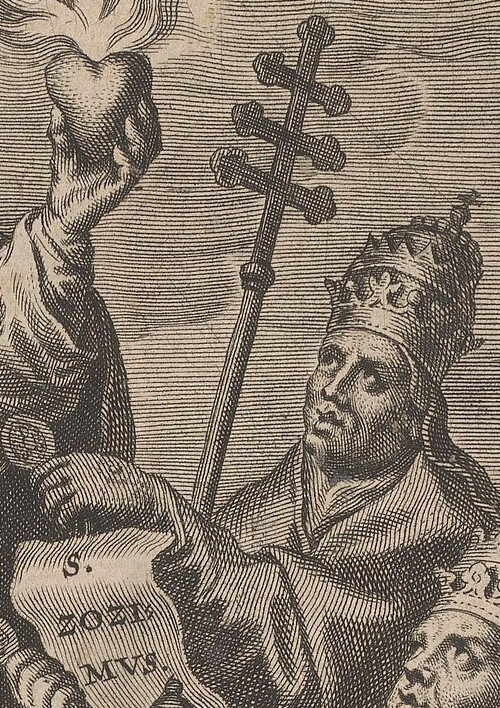
Zosimus (Greek Zōsimos, 'survivor') succeeded Innocent I as Bishop of Rome on March 18, 417, and governed the Roman Christian community for 21 months. His brief pontificate was dominated by the great Pelagian crisis — the foundational doctrinal controversy over the nature of grace and human freedom prompted by the British monk Pelagius (active at Rome from c. 400) and his disciple Celestius.
Pelagius and Celestius had been condemned by African councils convened by Augustine of Hippo (the Council of Carthage of 411 had condemned Celestius; the Councils of Carthage and Milevis of 416 had condemned Pelagius). The condemnations were forwarded to Rome for ratification. When Zosimus succeeded Innocent in early 417, Pelagius and Celestius personally appealed to Rome, presenting documents (the Libellus Fidei of Pelagius) that Zosimus initially read as exonerating them. He wrote to the African bishops asking them to reconsider their condemnation.
Augustine and the African episcopate responded with the great Council of Carthage of May 1, 418 — attended by 200 African bishops — which formally condemned Pelagius in nine extensive canons and submitted them to Rome with the supporting evidence Zosimus had not been shown. The Emperor Honorius simultaneously issued the imperial Edict of April 30, 418 condemning Pelagius and Celestius. Zosimus — having read the new African evidence — issued the foundational Roman papal condemnation of Pelagianism, the Epistola Tractatoria of summer 418 (now lost, but extensively quoted in later sources), formally ratifying the African condemnation and excommunicating Pelagius and Celestius. The episode is the foundational early-Catholic example of the Roman-African doctrinal collaboration that would define the post-Patristic Latin theological tradition.