
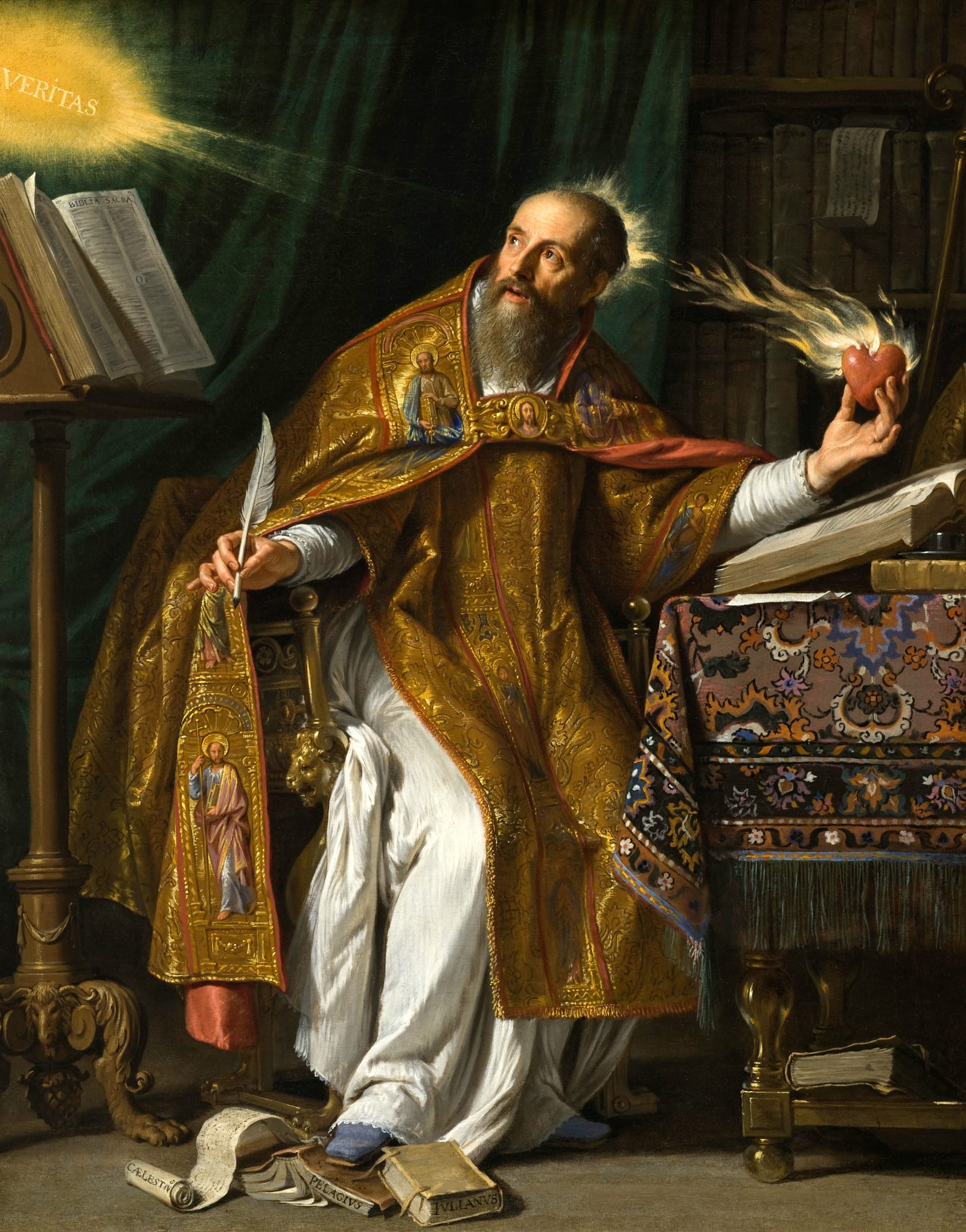
Possidius (Latin Possidius) was a young North African Numidian Catholic who joined the small monastic community that Augustine of Hippo had founded at Hippo Regius (see Augustine's entry already in the catalogue) in the late 380s, after Augustine's ordination as priest at Hippo. He lived in Augustine's monastic-episcopal household for some twenty years, became one of his closest personal collaborators, and around 397 was consecrated by Augustine as Bishop of the neighbouring small Numidian see of Calama.
He governed the small Calama Catholic community for over 40 years, through the entire catastrophic period of the North African Donatist schism, the Pelagian crisis, and finally the Vandal invasion of Roman North Africa. He was with Augustine at the great Council of Carthage of 411 (the foundational anti-Donatist conciliar event), at the great Council of Carthage of 418 (the foundational anti-Pelagian conciliar event), and at the long Vandal siege of Hippo of 430 — at which Augustine died on August 28 in the middle of the siege (see Augustine's entry).
After Augustine's death and the Vandal capture of Hippo, Possidius — having survived the siege at Hippo — fled to Calama, where he continued to govern the see briefly before being himself expelled by the Vandals around 437. He died in exile around 440.
His historical importance: Possidius composed, between Augustine's death in 430 and his own death around 440, the foundational Vita Augustini (Life of Augustine) — the only contemporary biography of Augustine written by someone who had personally lived with him for decades. The Vita is one of the most historically valuable 5th-century Latin Christian biographies and the foundational source for everything we know about Augustine's personal life, daily monastic-episcopal routine, methods of pastoral work, scholarship habits, and death. Possidius also compiled the foundational systematic catalogue of Augustine's writings (the Indiculum), which preserved the inventory of Augustine's library at Hippo before the Vandal destruction and is the foundational document for the textual history of the Augustinian corpus.