
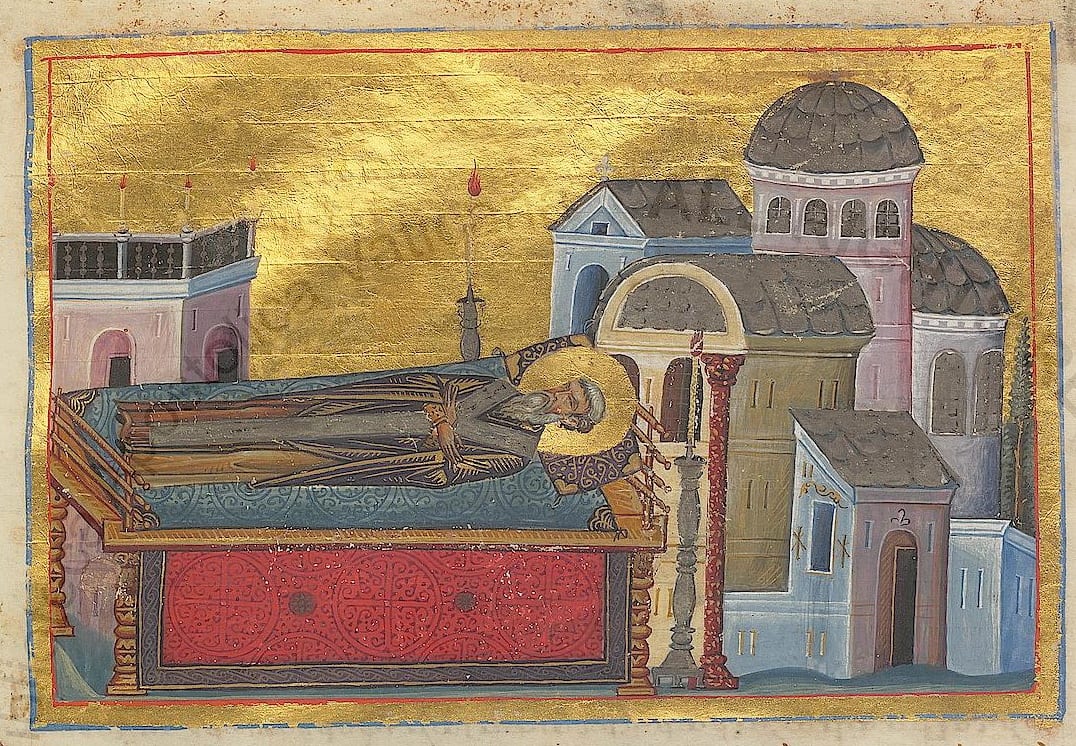
Proclus (Greek Proklos) was — per the contemporary historical sources — a personal disciple of John Chrysostom (see Chrysostom's entry already in the catalogue) during John's years as Patriarch of Constantinople (397–404). After John's deposition and exile in 404, Proclus remained at Constantinople under successive patriarchs, was eventually ordained priest, and was elected Patriarch of Constantinople himself on April 12, 434.
He governed the Patriarchate of Constantinople for twelve years through the difficult immediate aftermath of the Council of Ephesus of 431 (the foundational conciliar definition of the Theotokos against the Nestorian denial). Proclus's particular contribution to the Ephesian-Theotokos theological tradition was his famous Sermon on the Mother of God — preached at Constantinople around 428 AD, while Nestorius was still Patriarch and was opposing the title Theotokos — in the presence of Nestorius himself. The sermon was one of the foundational rhetorical-theological events that began the formal theological crystallization of the Theotokos doctrine that the Council of Ephesus would formally define three years later. The sermon, preserved intact in Greek, is one of the foundational early-Catholic Marian theological texts.
As Patriarch, Proclus was particularly known for his liturgical-pastoral work: he is widely credited with the introduction of the Trisagion ('Holy God, Holy Mighty One, Holy Immortal One, have mercy on us') into the Byzantine liturgical tradition, where it has remained as a foundational liturgical formula in continuous use to this day. The medieval tradition (preserved by the Synaxarion) holds that the Trisagion was first sung by an angelic vision at Constantinople during an earthquake of 437; Proclus had it incorporated into the Constantinopolitan liturgy in response.
He also presided over the formal translation of the body of his master John Chrysostom from the exile-tomb at Comana (where Chrysostom had died in 407) to Constantinople in 438 — the foundational liturgical-political vindication of Chrysostom's posthumous memory, attended publicly by the Emperor Theodosius II and his sister Pulcheria. He died at Constantinople on July 24, 446 AD.