
MIRACULOUS MIRACLES™

Saint — Procopius of Sázava

St. Procopius of Sázava
c. 970 AD, Chotouň, Bohemia (Czech noble family) — March 25, 1053 AD, Sázava Abbey, Bohemia
Bohemian hermit-abbot; founder of Sázava Abbey; patron of the Czech Catholic tradition
Sázava Monastery (Sázavský klášter), Sázava, Czech Republic — his foundation of c. 1032; the principal Slavonic-rite Catholic monastery in central Europe; in modified continuous use to the present day, Czech Republic
Feast
March 25 (Latin Catholic); July 4 (in the Czech Catholic calendar — the translation of relics, 1204)
Canonized
Canonized July 4, 1204 by Pope Innocent III
Life

Procopius (Czech Prokop) was born around 970 to a Czech noble family at Chotouň near Český Brod in Bohemia. Educated at the cathedral school of Prague (the Czech episcopal see established by Bishop Dietmar in 973 under the Otto II – Wolfgang of Regensburg ecclesiastical reorganization), he became a secular priest and married.

After the early death of his wife and the maturation of his son Jimram (who himself became a monk), Procopius undertook the hermit life — withdrawing to a remote cave-hermitage on the Sázava river in central Bohemia, where he lived alone for years in extreme ascetic discipline.

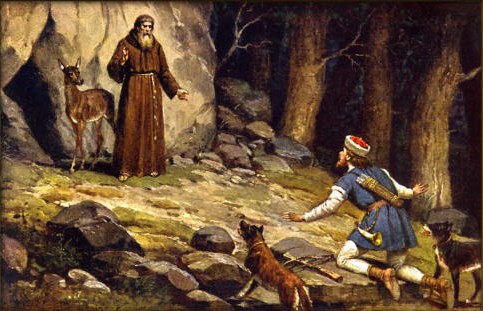
Around 1032, the Bohemian Duke Oldřich (Ulrich) of the Přemyslid dynasty discovered Procopius's hermitage during a hunting expedition (pursuing a stag that had led him to the saint's cave) — and, impressed by Procopius's sanctity, endowed the hermitage with royal lands for the foundation of the Sázava Monastery.

The Sázava Monastery — under Procopius's abbacy from c. 1032 to his death in 1053 — was the principal Slavonic-rite Latin Catholic monastery in central Europe: celebrating the Catholic liturgy in Old Church Slavonic (the Cyrillo-Methodian liturgical heritage inherited from Great Moravia) under Roman papal jurisdiction. The Sázava monastic tradition was the principal repository of the distinctive Czech-Slavonic Catholic liturgical-cultural heritage that bridged the Latin Western Catholic tradition with the Slavonic-Cyrillic Eastern Catholic tradition.

After Procopius's death on March 25, 1053, the Slavonic-rite Sázava community continued under his disciples — but was repeatedly disrupted by the tensions with the Latin-rite Czech episcopate. In 1097, the Latin party prevailed, the Slavonic-rite Sázava monks were expelled to Hungarian Vyšehrad, and the Sázava community adopted the Latin Roman rite — though the Procopian-Slavonic cultural memory persisted in Czech Catholic identity.

His canonization by Pope Innocent III on July 4, 1204 — at the request of King Přemysl Otakar I of Bohemia — established his Czech national-saint cult, placing him alongside Sts. Wenceslas, Ludmila, and Adalbert as the principal Czech national saints.

Miracles & Phenomena
  • The Slavonic-rite Sázava Monastery

    Procopius's establishment of the Sázava Monastery as the principal Slavonic-rite Latin Catholic monastery in central Europe — preserving the Cyrillo-Methodian Old Church Slavonic liturgical heritage under Roman papal jurisdiction at the confluence of the Latin Western and the Slavonic Eastern Catholic traditions — produced the distinctive Czech-Slavonic Catholic liturgical-cultural tradition that bridged the divided 11th-century Catholic-Orthodox East-West tradition. Although the Slavonic-rite Sázava community was Latinized in 1097, the Procopian-Slavonic cultural memory persisted in Czech Catholic identity and underpinned the 14th-century revival of the Slavonic Catholic liturgy at the Emmaus Monastery in Prague (founded 1347 by Emperor Charles IV).

  • The hunt-vision-foundation pattern

    The tradition of Duke Oldřich's hunt-foundation of the Sázava Monastery — the Duke pursuing a stag that led him to the saint's cave-hermitage in the deep forest of central Bohemia — is the classic Slavic-Catholic foundation-narrative pattern, parallel to the analogous foundation-traditions across central-and-eastern Europe (St. Eustace, St. Hubert). The Procopian-Oldřich foundation-narrative remains constitutive of the Czech Catholic national-religious identity.

Relics
  • Body
    Relics of St. Procopius of Sázava
    Originally Sázava Monastery (in cave-tomb, 1053–1588); principal relics translated to the Cathedral of All Saints, Prague Castle, in 1588 by Emperor Rudolf II; fragmentary relics remain at the Sázava Monastery

    His principal relics rest today at the Cathedral of All Saints (Kostel Všech svatých) at Prague Castle — translated there in 1588 by Emperor Rudolf II. The Sázava Monastery survives in modified continuous use as a Catholic-cultural site; fragmentary relics remain at the original tomb.

Iconography
  • Procopius ploughing with the devil

    The mid-11th-century Czech hermit-abbot in Benedictine habit compelling a defeated devil to pull the plough through the fields of the Sázava Monastery, the saint's pastoral staff restraining the chained demon — the standard Czech Catholic iconography of Procopius, celebrating his reputation for decisive spiritual victory over demonic temptation and his practical agricultural-monastic discipline of the Bohemian forest-lands.

Patronages
The Czech Catholic tradition (one of the principal Czech national saints alongside Sts. Wenceslas, Ludmila, Adalbert of Prague, and John of Nepomuk)Catholic Slavonic-rite Latin Catholic tradition (the distinctive Czech-Slavonic liturgical heritage)Catholic hermit-foundersCatholic protection against demons (his famous wrestling-with-the-devil iconography)