
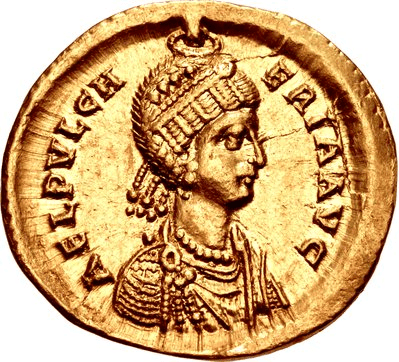
Aelia Pulcheria (Latin Pulcheria, 'beautiful') was the eldest surviving daughter of the Eastern Roman Emperor Arcadius and the Empress Eudoxia. Her father died when she was nine; her younger brother Theodosius II became emperor at the age of seven. Pulcheria — the eldest of the imperial siblings — was given the title Augusta of the Eastern Roman Empire on July 4, 414, at the age of fifteen, and effectively governed the Eastern Empire alongside her young brother through her teens and twenties.
She made a formal personal vow of consecrated virginity at fifteen in 414 — together with her two younger sisters Arcadia and Marina — and remained virgin throughout her life. The famous Theodosian-dynasty consecrated-virgin imperial household (Pulcheria and her two sisters living in religious community within the imperial palace at Constantinople) was one of the examples of late-antique Catholic women's consecrated-virgin life adapted to the unprecedented circumstances of an imperial court.
She was a patron of the Theotokos devotion at Constantinople. She built and dedicated three of the great Marian churches of Constantinople — the Hodegon, the Chalkoprateia, and the Blachernae — making them collectively the principal Marian devotional infrastructure of the Eastern Empire. The Hodegon was the shrine of the Hodegetria icon (the 'Pointing Theotokos' — the most-influential single Marian icon-type in the entire Eastern Christian tradition); Pulcheria commissioned the original Hodegetria icon herself, per the Byzantine tradition.
She was a major political-doctrinal force in the long Nestorian crisis of the late 420s and early 430s. At the Council of Ephesus of 431, Pulcheria's substantial political-imperial support was decisive in the Theotokos definition. Then, after the catastrophic Robber Council of Ephesus of 449 (the Monophysite-controlled council that had reversed the Ephesine-Theotokos line), Pulcheria — now a 51-year-old experienced political-religious leader — was decisive in the convocation of the great Council of Chalcedon of 451. She married the new Emperor Marcian in July 450 (a formal marriage retaining her virginal status) to provide the imperial legitimacy needed for the council. She personally attended the Council and intervened decisively for the Chalcedonian definition of the two natures of Christ.
She died at Constantinople in July 453, two years after Chalcedon. She is venerated as a joint patron of the Council of Chalcedon alongside Pope Leo the Great (see Leo's entry already in the catalogue).