
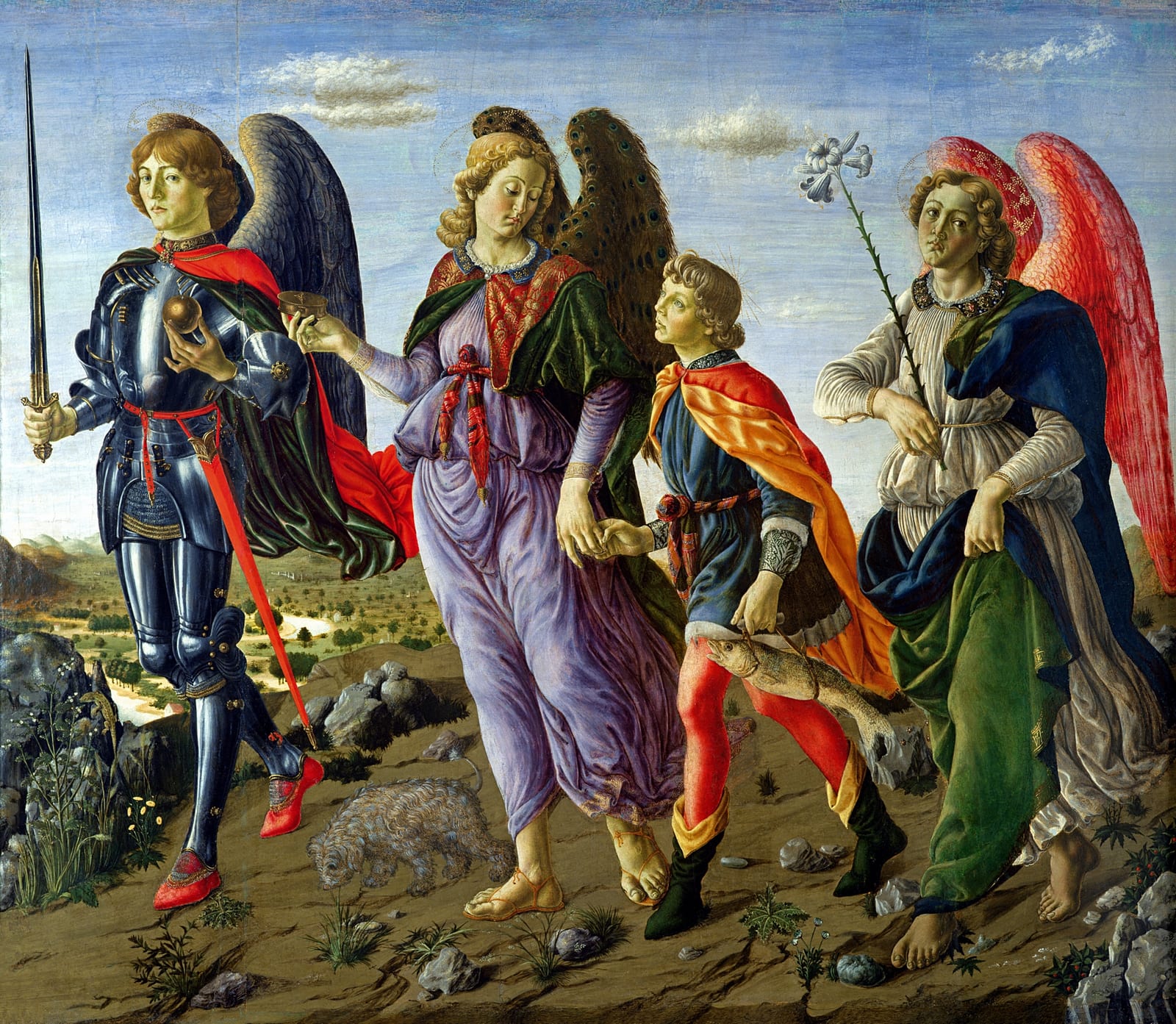
<em>Rapha-el</em>, 'God heals'. He is known from one book, and everything the Church asks of him comes out of it. In the Book of Tobit he walks the road from Nineveh to Media and back as a hired companion to the young Tobias, binds the demon that had killed Sara's seven husbands on their wedding nights, arranges the marriage, and heals the blindness of old Tobit with the gall of a fish. Only at the end does he say what he is: 'I am the angel Raphael, one of the seven who stand before the Lord' (Tobit 12:15).
Three offices, therefore, and three patronages: the road, the marriage, and the healing. Pilgrims have invoked him on setting out since the Middle Ages, and the Roman Breviary keeps an <em>Itinerarium</em> for those about to travel that asks 'may the Angel Raphael be with us along the way, that we may come to our home again in peace, and health, and gladness'.
He is also the saint the canon question touches. Tobit is one of the seven deuterocanonical books that the reformers moved out of the Old Testament in the sixteenth century and that Trent restated as Scripture in 1546. Catholics and Orthodox therefore know Raphael by name; most Protestants do not, because the only book that names him is not in their Bible. The story of that division is told on this site under How We Got the Bible.
His greatest Western shrine is at Cordoba, which keeps him as <em>custodio</em> — appointed guardian of the city. During the plague of 1578 the priest Andres de las Roelas reported that the archangel appeared to him and said, 'I am Raphael, the angel whom God has appointed guardian of this city.' The Triunfos de San Rafael, columns crowned with his figure, stand about Cordoba still. His feast was 24 October until the calendar of 1969.