
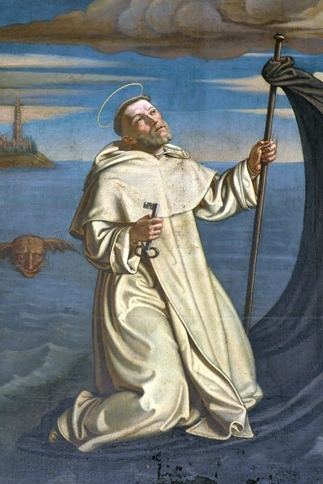
Raymond was educated at the cathedral school of Barcelona and at the University of Bologna, where he taught canon law for a decade. He returned to Barcelona as a canon, witnessed the simultaneous Marian vision of August 1, 1218 that founded the Mercedarian Order (which he helped Peter Nolasco draft and confirm), and in 1222 — at the age of forty-seven — entered the Dominicans.
Pope Gregory IX summoned him to Rome in 1230 and commissioned him to compile a definitive collection of papal decretals — the legislative material that had accumulated since Gratian's Decretum of c. 1140. Raymond's five-book Liber Extra (formally Decretales Gregorii IX), promulgated in 1234, became the second of the basic compilations of the Corpus Juris Canonici, the basic body of Catholic canon law used by every western lawyer and ecclesiastical court until the 1917 Code. He is the principal architect of the medieval Catholic legal tradition.
He was elected Master General of the Dominicans in 1238 — succeeding Jordan of Saxony — but resigned in 1240 to return to pastoral work in Catalonia, where he founded the great Studium Arabicum at Tunis and Murcia (a school for training Dominican missionaries in Arabic for engagement with Islam), advised King James I of Aragon, and persuaded Thomas Aquinas to write the Summa contra Gentiles as a missionary handbook for the Spanish Dominicans engaging with Muslim and Jewish scholars in Andalusia. He died at the Dominican convent of Santa Caterina in Barcelona in January 1275, aged about a hundred.