
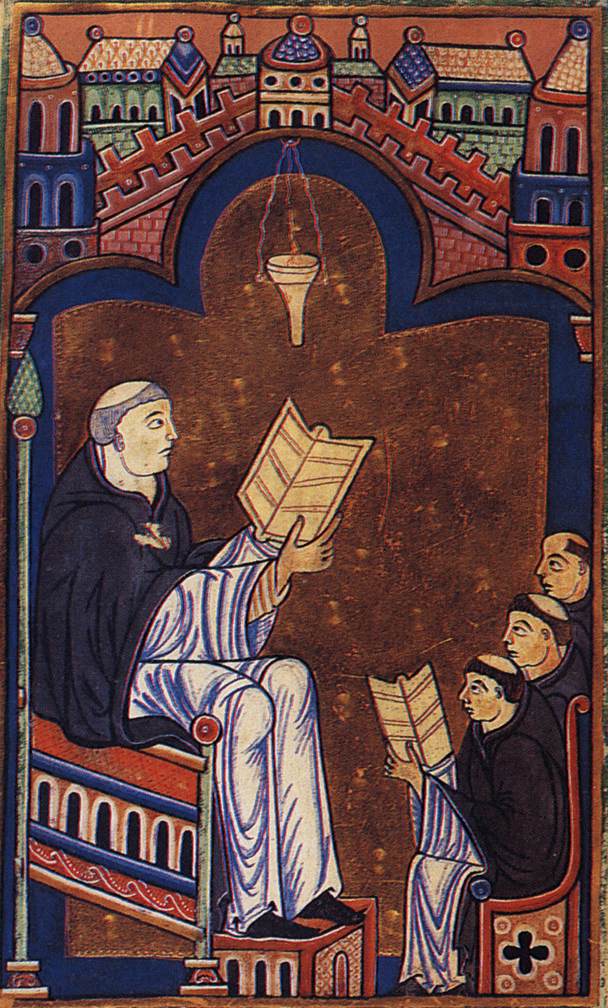
Richard, of Scottish origin (the medieval tradition is unanimous on this; precise birthplace unknown), entered the Abbey of Saint-Victor in Paris under Hugh and succeeded him as the great teacher of the Victorine school. He became sub-prior in 1159 and prior in 1162 — a difficult tenure under a turbulent abbot named Ervisius whose dispute with the community went all the way to Pope Alexander III for adjudication.
His theological writings — Benjamin Minor and Benjamin Major (an allegorical-mystical exposition of the Ark of the Covenant and the contemplative ascent), De Trinitate (a rigorous philosophical theology of the Trinity that profoundly influenced Bonaventure and Aquinas), and the brief but luminous De Quatuor Gradibus Violentae Caritatis ('On the Four Degrees of Violent Charity') — define the high Victorine mystical tradition. Dante placed him in the Sun-Heaven of the Doctors in the Paradiso: 'Riccardo, che a considerar fu più che viro' ('Richard, who at contemplation was more than a man').
His insistence that contemplative experience could be analyzed rigorously, that mystical love had its own dialectical structure, and that the Trinity could be understood through the analogy of perfect love (an analogy Bonaventure would develop a century later), shaped the entire later medieval Latin mystical tradition. He died at the abbey in 1173 and was venerated as Blessed in the Augustinian Canons.