
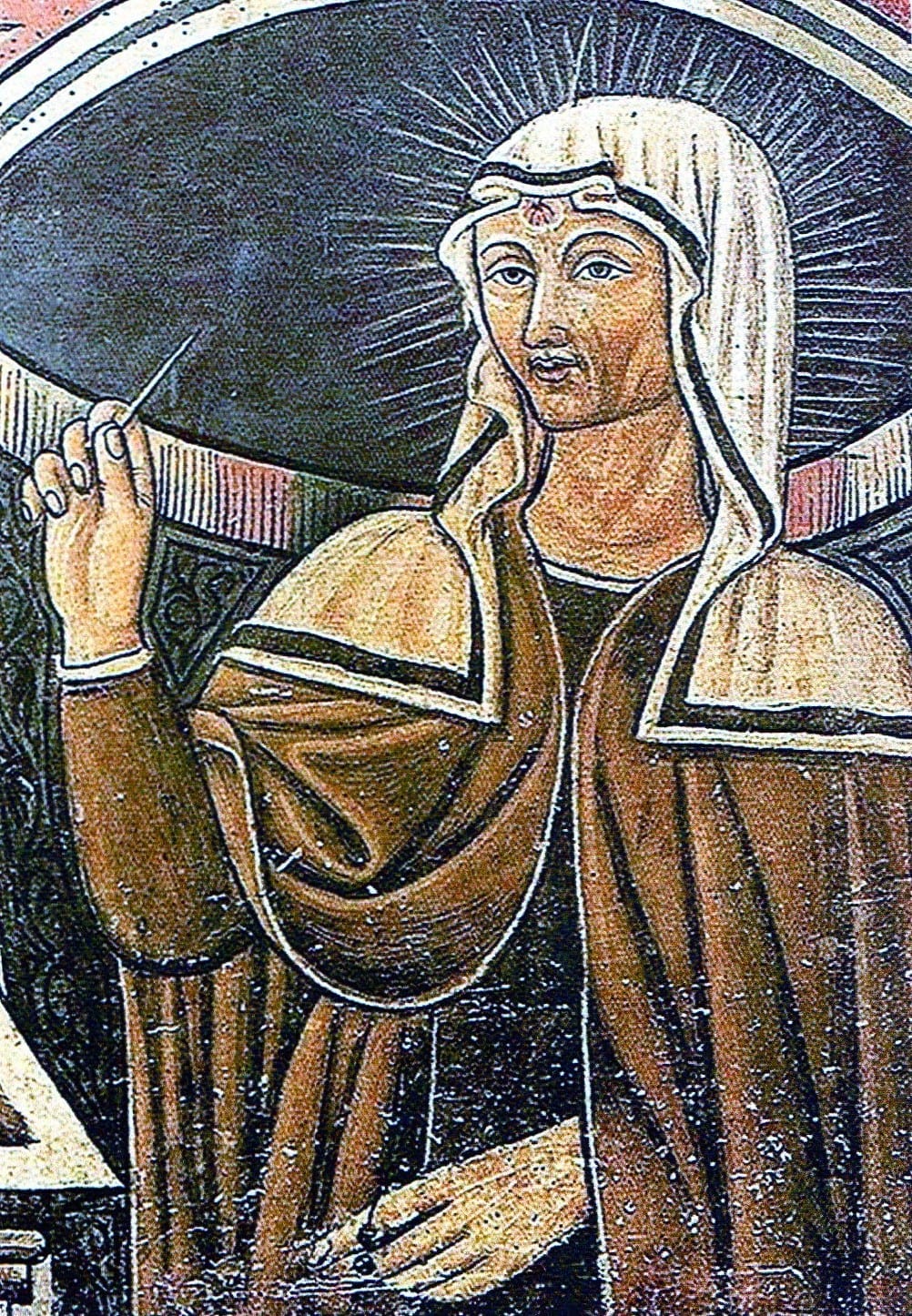
Margherita Lotti was born to elderly parents in the small village of Roccaporena outside Cascia. She wished to enter the local Augustinian convent at twelve, but her parents — needing the support — pressured her into marriage at eighteen to Paolo Mancini, a brutal and abusive man involved in the feuds of the Umbrian mountain country. She endured the marriage for eighteen years, bore him two sons, and (according to tradition) gradually moved her husband to a less violent way of life.
Paolo was murdered in a feud around 1399. Rita publicly forgave the killers and refused to support her two sons' attempts at vengeance — for which she prayed that the sons would die before they could shed blood. Both died of disease within a year (some sources say plague, others fever). After their deaths, in middle age, she finally entered the Augustinian convent of Santa Maria Maddalena at Cascia in 1407 — a foundation that had initially refused her three times because of her family's blood-vendetta involvement.
She lived as a nun at Cascia for forty years. From 1442 she bore a thorn-wound on her forehead — produced (in her account) by a vision of Christ crucified, when one of the thorns from his crown detached itself and pierced her — a stigmatic phenomenon that lasted for the remaining fifteen years of her life and that her sisters had to bandage daily because of the constant infection. She died at Cascia on May 22, 1457. Her body was placed in a wooden coffin and, per the unanimous tradition, has remained substantially incorrupt for over five and a half centuries — currently on display in a crystal coffin at the basilica of Cascia. Canonized in 1900, she is invoked across the Catholic world for impossible causes.