
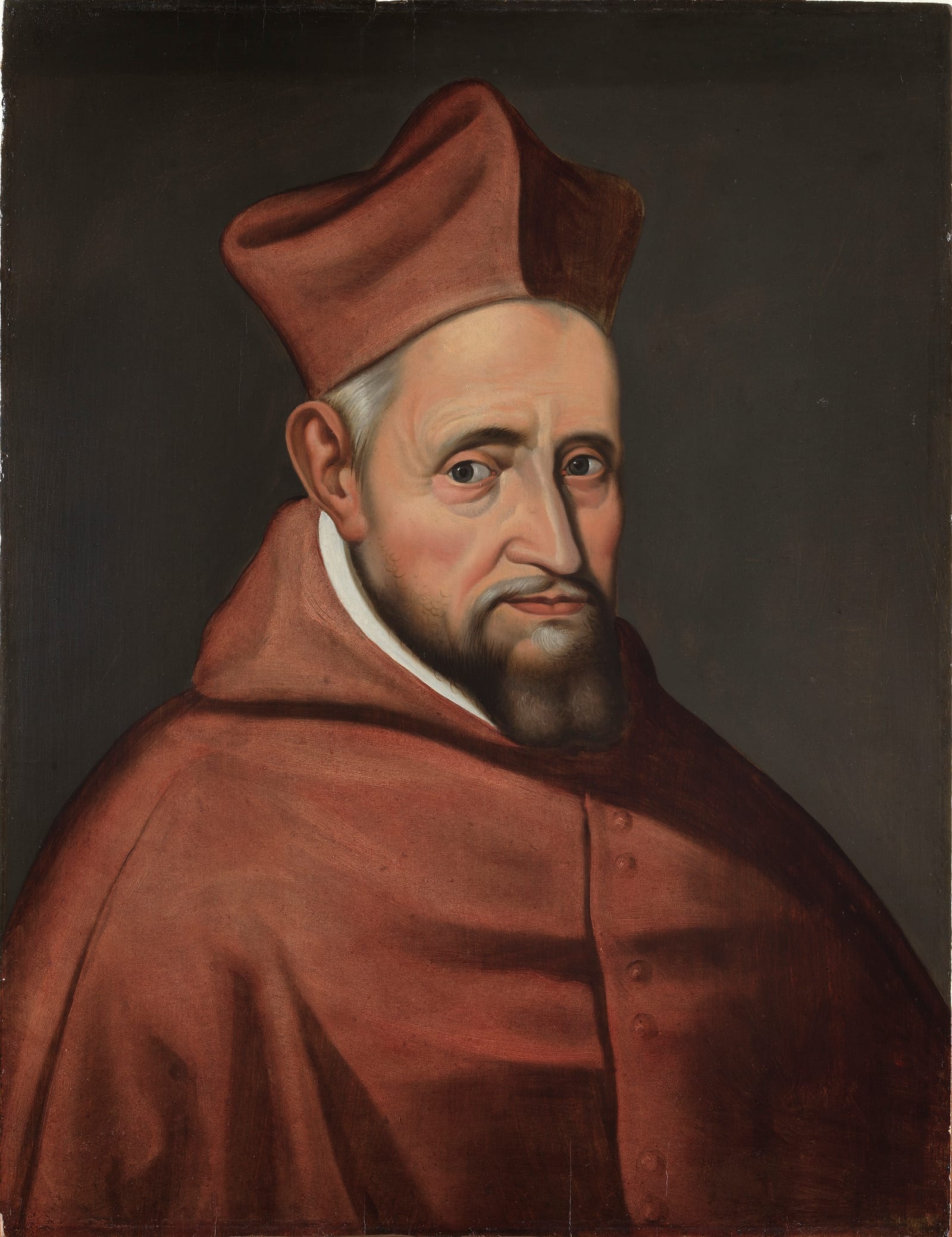
Roberto Bellarmino was nephew on his mother's side to Pope Marcellus II. Brilliant from boyhood — he had translated Virgil's Georgics into Italian by the time he was fourteen — he entered the Society of Jesus in 1560. He was sent to teach at the new University of Louvain, then to the Roman College, where for eleven years he held the chair of Controversial Theology established by Gregory XIII specifically to refute Protestant doctrine.
From those lectures came the Disputationes de controversiis Christianae fidei (1586–93) — three folio volumes that systematically engaged the major Reformers on every contested point of doctrine. The work was so formidable that Protestant universities established chairs of 'anti-Bellarmine' theology to teach generations of refutations of it.
Made Cardinal by Clement VIII (1599) and briefly Archbishop of Capua, he was active in the Curia under Clement VIII, Leo XI, and Paul V. He served as inquisitor in two consequential trials: that of Giordano Bruno (condemned and burned at the stake, 1600 — Bellarmine concurred in the verdict on doctrinal grounds) and the first phase of the Galileo case (1616), where he met Galileo privately, warned him against teaching the Copernican system as physical fact rather than mathematical hypothesis, and signed the cautionary admonition. He wrote spiritual works of great gentleness in his final years (The Mind's Ascent to God by the Ladder of Created Things, The Art of Dying Well), gave his cardinal's tapestries away to the poor in time of famine, and died on the same day as another Jesuit, Aloysius Gonzaga, twenty years his junior.