
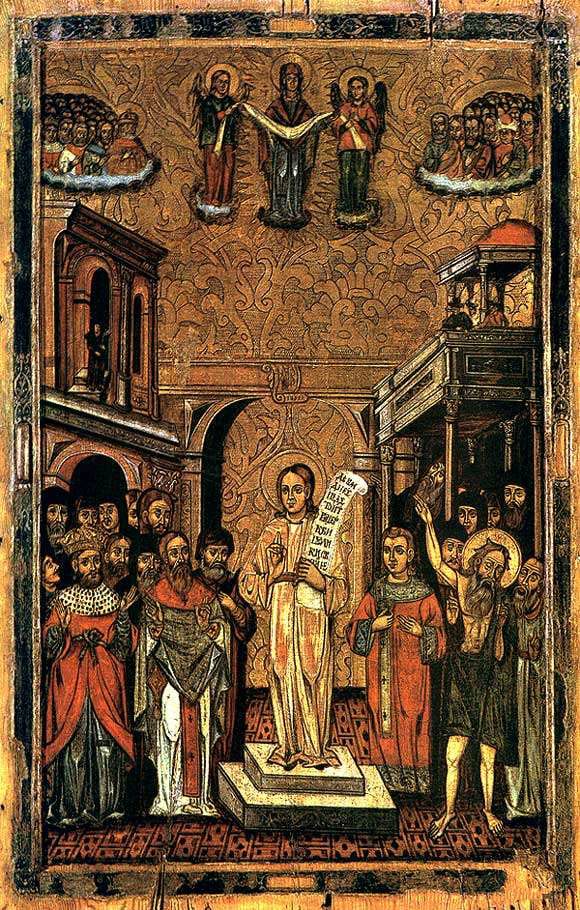
Romanos was a Syrian deacon of the Church of Beirut who came to Constantinople in the reign of Anastasius I (491–518) and served at the Church of the Theotokos at the Kyrou quarter under Patriarch Euphemius. He was, in his early years, a singer of no great talent, often mocked by his fellow clergy.
On Christmas Eve, according to his biographers, the Mother of God appeared to him in a dream, gave him a scroll of parchment, and told him to swallow it. He awoke filled with the gift of sacred song. He took the ambon that night and chanted his great Nativity kontakion — 'Today the Virgin gives birth to Him who is above all being' — which has remained the central hymn of the Byzantine Christmas liturgy ever since.
He went on to compose over a thousand kontakia (long sung sermons) during his lifetime — some sixty of which survive. Through them he transformed Byzantine liturgical hymnography into the rich tradition that descends through the Great Canon of St. Andrew of Crete and the hymns of St. John Damascene to the present day Eastern liturgies.