
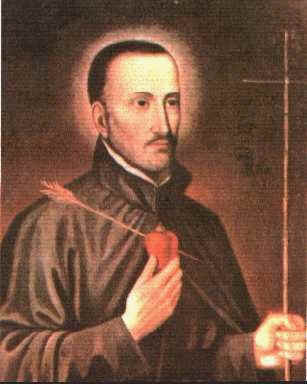
Roque González de Santa Cruz was born at Asunción to a Spanish-Guaraní mestizo family of the early colonial elite — making him one of the very first criollo (American-born) priests in colonial South America. He was ordained priest in 1599, served briefly at the Asunción cathedral, and entered the Jesuits at twenty-eight in 1609. He was sent immediately to the new Guaraní missions on the upper Paraná river.
He spent the rest of his life — twenty-eight years — in the great Jesuit Reductions system: a network of indigenous Christian villages, autonomous from both Spanish and Portuguese colonial administration, in which Guaraní communities lived under Jesuit pastoral and economic direction. He founded the reductions of San Ignacio Miní (1611), Santa Ana (1613), Itapua (1615, the future Encarnación), Concepción, Yapeyú, and ten others — an aggregate population eventually of well over 100,000 Guaraní Catholics speaking their own language, with their own polyphonic music, written literature, and skilled artisanal crafts.
On November 15, 1628, at the new reduction of Caaró on the upper Uruguay (in territory contested between Spanish Paraguay and Portuguese Brazil), a war-party led by the resistant tribal shaman Ñesú attacked Roque and his companion Alonso Rodríguez at the chapel. Roque was killed with a stone axe at the altar; his heart was cut out and burned. Alonso Rodríguez was killed shortly after, and another Jesuit, Juan del Castillo, two days later at the neighbouring reduction of Ijuhí. The three were canonized together by John Paul II at Asunción in 1988. The reductions system itself, despite intense Portuguese-Spanish pressure, persisted for another century and a half until the suppression of the Jesuits in 1773 — the foundation of Guaraní cultural Catholic identity in modern Paraguay, Argentina, and southern Brazil.