
MIRACULOUS MIRACLES™

Saint — Rose of Lima

St. Rose of Lima
April 20, 1586, Lima — August 24, 1617, Lima
First Canonized Saint of the Americas — Patroness of the New World
Sanctuary of Santa Rosa de Lima, Lima, Peru
Feast
August 23 (formerly August 30)
Canonized
April 12, 1671 by Pope Clement X — first saint canonized from the Western Hemisphere
Life

Isabel Flores de Oliva was born at Lima to a Spanish-Andean family of modest means — her mother a creole of mixed Spanish-Andean descent. Her childhood nickname 'Rosa' became her official baptismal name when Archbishop Toribio de Mogrovejo personally confirmed her at thirteen. From early childhood she practiced severe self-mortification — wearing a self-imposed crown of thorns, refusing all sweets, rubbing pepper on her face to disfigure her unusual beauty. She refused all proposals of marriage.

In 1606 she entered the Dominican Third Order as a tertiary and was permitted by her confessors to live as an anchoress in a small hermitage in the garden of her parents' house. From this small cell she spent eleven years (1606–17) in continuous prayer, embroidery (the labour by which she supported her parents), and care for the poor and the sick of Lima — whom she received daily in the family kitchen. She was the friend of Martin de Porres (the half-Spanish, half-Panamanian Dominican lay brother) and of Juan Masías (the Spanish-born Dominican lay brother), both of whom worked the same Lima streets she did.

Her mystical writings — only fragments survive, but they were celebrated in her lifetime — describe a sustained mystical marriage to Christ. She died at thirty-one on August 24, 1617, after years of progressive physical breakdown from her self-imposed penances. Her funeral was the largest in the colonial history of Lima — the magistrates of the city carried her body. She was beatified in 1667 and canonized in 1671 — the first canonized saint from the Western Hemisphere. Patroness of the New World by papal proclamation since 1670, and the personification of Latin American Catholic identity.

Miracles & Phenomena
  • The crown of thorns

    From around fifteen she wore a self-made crown of thorns continuously, hidden beneath a wreath of roses — a phenomenon attested by family witnesses and confessors and central to her cult.

  • Conversion of pirates

    When Dutch corsairs threatened Lima in 1615 (an episode recorded in Lima civic history), Rose led a group of women into the cathedral to defend the Blessed Sacrament; her prayer is credited by tradition with the unexplained withdrawal of the Dutch fleet without sacking the city.

  • Lima cures and conversions

    The substantial dossier of post-mortem cures at her hermitage in Lima dominated the canonization case.

Relics
  • Body
    Body of St. Rose of Lima
    Sanctuary of Santa Rosa de Lima, Lima (small chapel built around her original hermitage)

    Her relics rest at the basilica of Santo Domingo in Lima, with the original hermitage (the small garden cell of her years as an anchoress) preserved adjacent. The well that she made (the 'Pozo de los Deseos' where she received the sick) remains a major pilgrimage focus.

Iconography
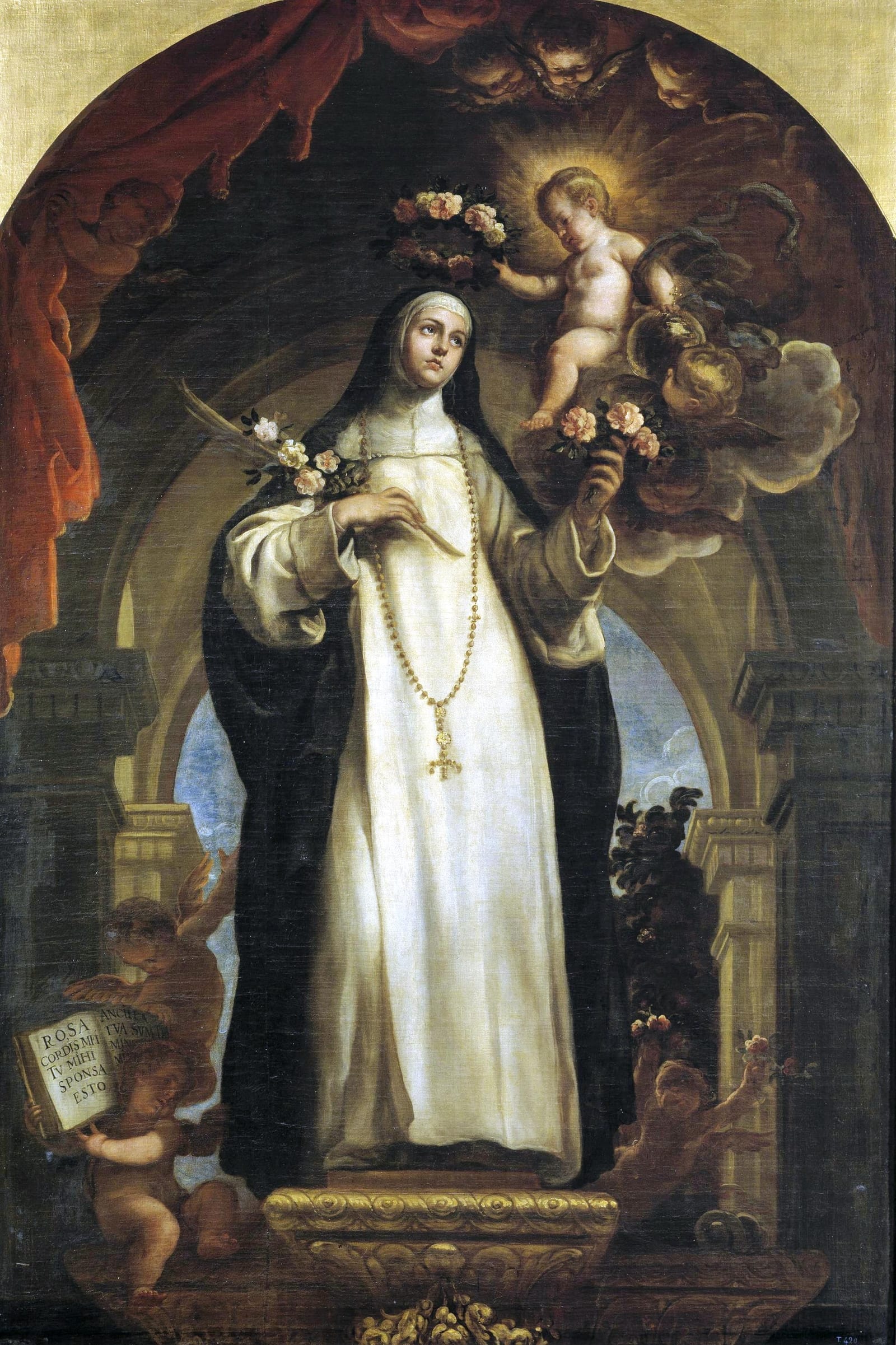
  • Rose with infant Jesus and roses

    The Dominican tertiary in white habit and black mantle with a crown of red and white roses, the infant Jesus in her arms — the iconography of the mystical marriage. Sometimes shown also with the crown of thorns half-hidden beneath the rose wreath.

Patronages
The Americas (declared 1670 by Clement X)PeruPhilippinesLatin AmericaIndigenous peoplesFloristsEmbroiderersDiocese of LimaPatroness of all the New World