
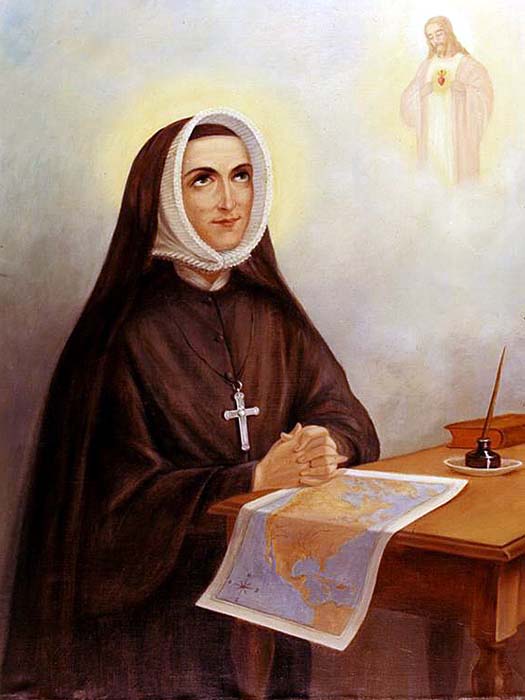
Rose Philippine Duchesne was born to a wealthy Grenoble lawyer and his devout wife. At eighteen she entered the Visitation convent of Sainte-Marie-d'en-Haut, which was suppressed within four years by the French Revolution. For ten years she sheltered priests in hiding, taught children in cellars, and visited prisoners in the Grenoble jails.
In 1804 she joined Madeleine Sophie Barat's newly founded Society of the Sacred Heart, taking with her the ruined convent she had bought back from the state. For twelve years she begged her superior to send her to the New World. In 1818, at forty-nine, she finally sailed — to a Louisiana that had been American for fifteen years.
She founded the first Sacred Heart convent and free school west of the Mississippi at St. Charles, Missouri, in 1818, then a second at Florissant, and seven more before she retired in 1840. She taught the daughters of French Creole settlers, freed Black children, and frontier farmers — anyone who would come. She was seventy-one.
Her final dream was to live among the Potawatomi. In 1841, at seventy-two, she travelled by riverboat up the Missouri to Sugar Creek, Kansas. She could not learn the Potawatomi language. She could not teach. She sat in the chapel, alone, hour after hour. The Potawatomi named her 'Quahkahkanumad' — 'the woman who prays always.' They left small offerings beside her, sometimes lifting the corner of her habit to see whether her knees had taken root. She lasted a year, was sent back to St. Charles in failing health, and lived another eleven years in a tiny cell at the convent she had founded, half-blind and refusing every comfort. She died there at eighty-three.