
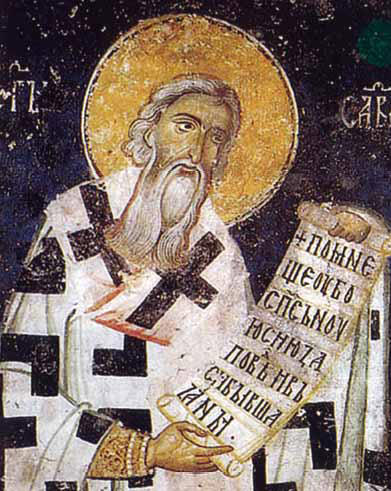
Sabbas (Serbian Sava, birth name Rastko Nemanjić) was born in 1174 to Grand Prince Stefan Nemanja of Raška (Serbia) — the founder of the medieval Serbian state and the royal Nemanjić dynasty that would rule Serbia for the 200 years.
At age 17 in 1191, Rastko fled the Serbian royal court to Mount Athos in Greece — taking the monastic habit at the Russian monastery of St. Panteleimon and subsequently at the Greek monastery of Vatopedi under the monastic name Sava (Serbian variant of Sabbas the Sanctified, the 5th-century Palestinian monastic founder).
In 1198, together with his father Stefan Nemanja (who had abdicated the Serbian throne to take the monastic habit under the monastic name Symeon — St. Symeon the Myrrh-Streaming), Sava founded the Monastery of Hilandar on Mount Athos — the Serbian monastery of the Athonite monastic republic, one of the principal monasteries of Mount Athos and the principal Serbian monastic-cultural centre for the eight centuries.
In 1219, Sava undertook the institutional action that would institutionally establish the Serbian national Catholic-Orthodox church: travelling to Nicaea (the Byzantine imperial capital in exile after the 1204 Latin Crusader capture of Constantinople), Sava obtained from the Ecumenical Patriarch Manuel I Sarantenos of Constantinople the autocephaly of the Serbian Church — the institutional independence of the Serbian ecclesiastical province from the previous jurisdiction of the Archbishopric of Ohrid, and the institutional elevation of Sava himself to be the first Archbishop of Serbia.
Sava returned to Serbia and established the Serbian ecclesiastical hierarchy — establishing eight suffragan bishops for the Serbian territory, organizing the Serbian Catholic-Orthodox liturgical and educational tradition. He established the archiepiscopal see at Žiča (later transferred to Peć).
He composed the Nomocanon of Saint Sava (Sveto-Savska Krmčija) — the Slavic-Serbian legal-canonical code that institutionally established the Serbian Catholic-Orthodox civil-and-ecclesiastical legal tradition, and the Life of Symeon the Myrrh-Streaming (the Latin-Serbian biography of his father).
In 1229 and again in 1234, Sava undertook the pilgrimages to the Holy Land, visiting Jerusalem, Nicaea, and the monasteries of Mar Saba (his namesake) and Sinai. On the return from the second pilgrimage, Sava died at Tarnovo (the Bulgarian imperial capital) on January 14, 1235.
His relics were translated to the Monastery of Mileševa in Serbia in 1237 by his nephew King Stefan Vladislav. On April 27, 1595 — during the Ottoman occupation of Serbia — the relics of Sava were publicly burned at Vračar Hill in Belgrade by Ottoman commander Sinan Pasha, an attempted symbolic destruction of the Serbian national identity. The site of the burning is now the site of the famous Church of St. Sava (Hram Svetog Save) in Belgrade — the largest Orthodox church in the Balkans, built 1935–2004 in commemoration.