
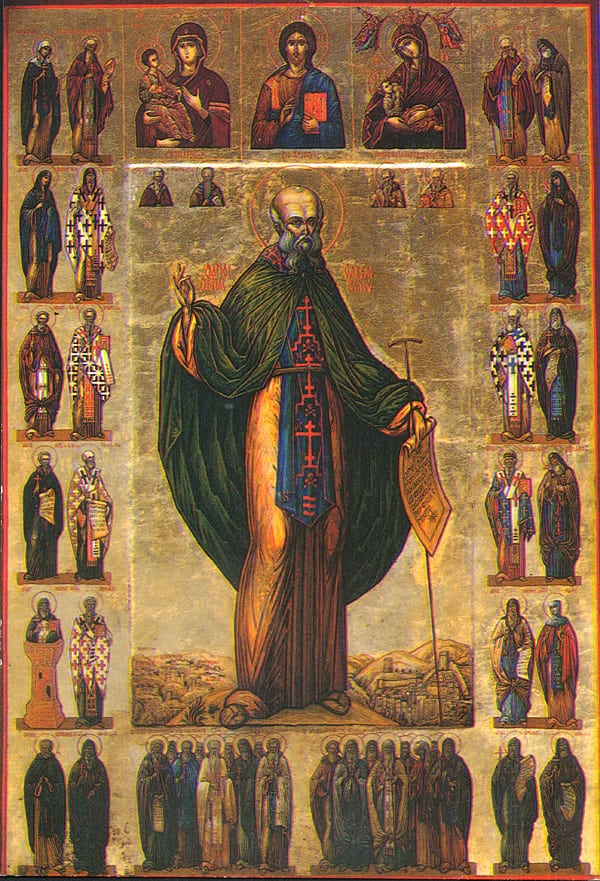
Sabbas was a Cappadocian monk who came to Palestine at eighteen and lived first in the great koinobion of St. Euthymius, then under St. Theoctistus, and then for years as a solitary hermit in caves of the Judean wilderness south of Jerusalem. Disciples gathered; in 483 he organized the Great Lavra — a settlement where monks lived in individual cells five days a week and gathered for common worship on Saturday and Sunday — in the canyon of the Kidron south of Bethlehem.
Eight more monasteries followed under his direction, distributed across the Judean desert. He was named archimandrite of all Palestinian hermits by Patriarch Sallustius of Jerusalem in 494. He traveled twice to Constantinople — once to oppose Monophysitism in 511, once to plead for Palestinians taxed beyond endurance in 530 — and impressed even hostile emperors with the gravity and gentleness of his bearing.
He died at the Lavra on December 5, 532, at ninety-three. The Great Lavra — Mar Saba — has been continuously inhabited since: among the oldest continuously functioning monasteries in the world. The liturgical Typikon developed there became the basis of the Byzantine rite of monastic worship still used today across the Orthodox world.