
MIRACULOUS MIRACLES™

Saint — Sadoc and Companions (Dominican Martyrs of Sandomierz)

St. Sadoc and Companions (Dominican Martyrs of Sandomierz)
c. 1200 AD, Silesia or Bohemia (Central European origin; disciple of St. Dominic and one of the first Dominican companions of St. Hyacinth of Poland) — June 2, 1260 AD, Sandomierz, Kingdom of Poland — massacred with 48 companion-friars by the second Mongol invasion of Poland (the Cuman-Tatar army of Burundai)
Polish Dominican martyrs (1260); Mongol-invasion protomartyrs of the Polish Dominican Province
Church of St. Jacob (Kościół św. Jakuba), Sandomierz, Poland — the site of the massacre; shrine of the 49 martyrs of Sandomierz; in continuous Catholic Dominican use to the present day, Poland
Feast
June 2
Canonized
Beatified October 18, 1807 by Pope Pius VII
✠ MartyrSlain with his 48 Dominican brethren by Tatar raiders at Sandomierz → The Martyrs
Life

Sadoc (Latin Sadoc; Polish Sadok) was one of the earliest Polish-Silesian Dominican friars — a close companion of St. Hyacinth of Poland (1185–1257, the Apostle of the Slavs, the founder of the Polish Dominican Province) in the earliest Dominican mission to Central Europe. Sadoc had received the Dominican habit directly from St. Dominic in Rome around 1220 (per tradition), and accompanied Hyacinth on the Polish mission.

By the late 1230s, Sadoc was serving as prior of the Dominican convent of Zagreb in Croatia. Around 1250 he was appointed prior of the Dominican Priory of St. James at Sandomierz in Lesser Poland (Małopolska) — the principal Dominican foundation in the Sandomierz region, founded around 1226 by Hyacinth himself.

In autumn 1259, the second Mongol invasion of Poland was launched by the Cuman-Tatar general Burundai (following the first Mongol invasion of 1240–1241, which had culminated in the Battle of Legnica of April 9, 1241). The Mongol-Cuman army swept across the Polish territory, sacking Kraków, Lublin, and the surrounding cities.

On the eve of the Feast of the Ascension (June 2, 1260), the Mongol-Cuman army arrived at Sandomierz. The Dominican community — 49 friars including Sadoc as prior — recognized that they could not escape and that the martyrdom was imminent.

Sadoc gathered the community in the church of St. James for the final Compline liturgy. According to the classic hagiographical tradition preserved in the Polish Dominican chronicles, a young friar received a vision at the reading of the martyrology in which he read the entry: 'At Sandomierz, the passion of the forty-nine martyrs.' Recognizing the imminent martyrdom, Sadoc led the community in the chanting of the Marian anthem Salve Regina — the famous Marian anthem composed in the late 11th century, the nightly Marian anthem of the Dominican Order.

The Cuman-Tatar army burst into the church of St. James at the moment of the chanting of the Salve Regina and massacred the entire community of 49 Dominicans — including Sadoc as prior — at the altar and the choir-stalls.

The 49 martyrs of Sandomierz were beatified by Pope Pius VII on October 18, 1807 — the papal recognition of the continuing Polish Catholic-Dominican devotion to the Sandomierz martyrs. The Church of St. James at Sandomierz survives in continuous Catholic Dominican liturgical use as the principal martyrdom-shrine.

Miracles & Phenomena
  • The Salve Regina at the moment of martyrdom

    The classic hagiographical tradition of the 49 Dominicans of Sandomierz chanting the Salve Regina Marian anthem at the moment of the Cuman-Tatar Mongol army bursting into the church of St. James — established the Dominican-Marian tradition of the Salve Regina as the nightly anthem of the Dominican Order. The Salve Regina, chanted by the Dominicans at the conclusion of every Compline liturgy since the 13th century (following the 1228 institution by Bl. Jordan of Saxony), became one of the principal Marian anthems of the entire Catholic Western tradition.

  • The Sandomierz Priory as continuous Dominican foundation

    The Church of St. James at Sandomierz — the site of the June 2, 1260 martyrdom — survives in continuous Catholic Dominican liturgical use to the present day, over 800 years of continuous Dominican foundation-history at the site of the Sandomierz massacre. The Church survives as the principal Dominican martyrdom-shrine of the Polish Catholic tradition.

Relics
  • Body
    Relics of Bl. Sadoc and the Sandomierz Martyrs
    Church of St. Jacob (Kościół św. Jakuba), Sandomierz, Poland — the tomb of the 49 martyrs; in continuous Catholic Dominican liturgical use to the present day

    The relics of the 49 Sandomierz martyrs rest at the Church of St. James in Sandomierz — the Dominican priory that has been in continuous Dominican use since 1226. The church survives as the principal Dominican martyrdom-shrine of the Polish Catholic tradition.

Iconography
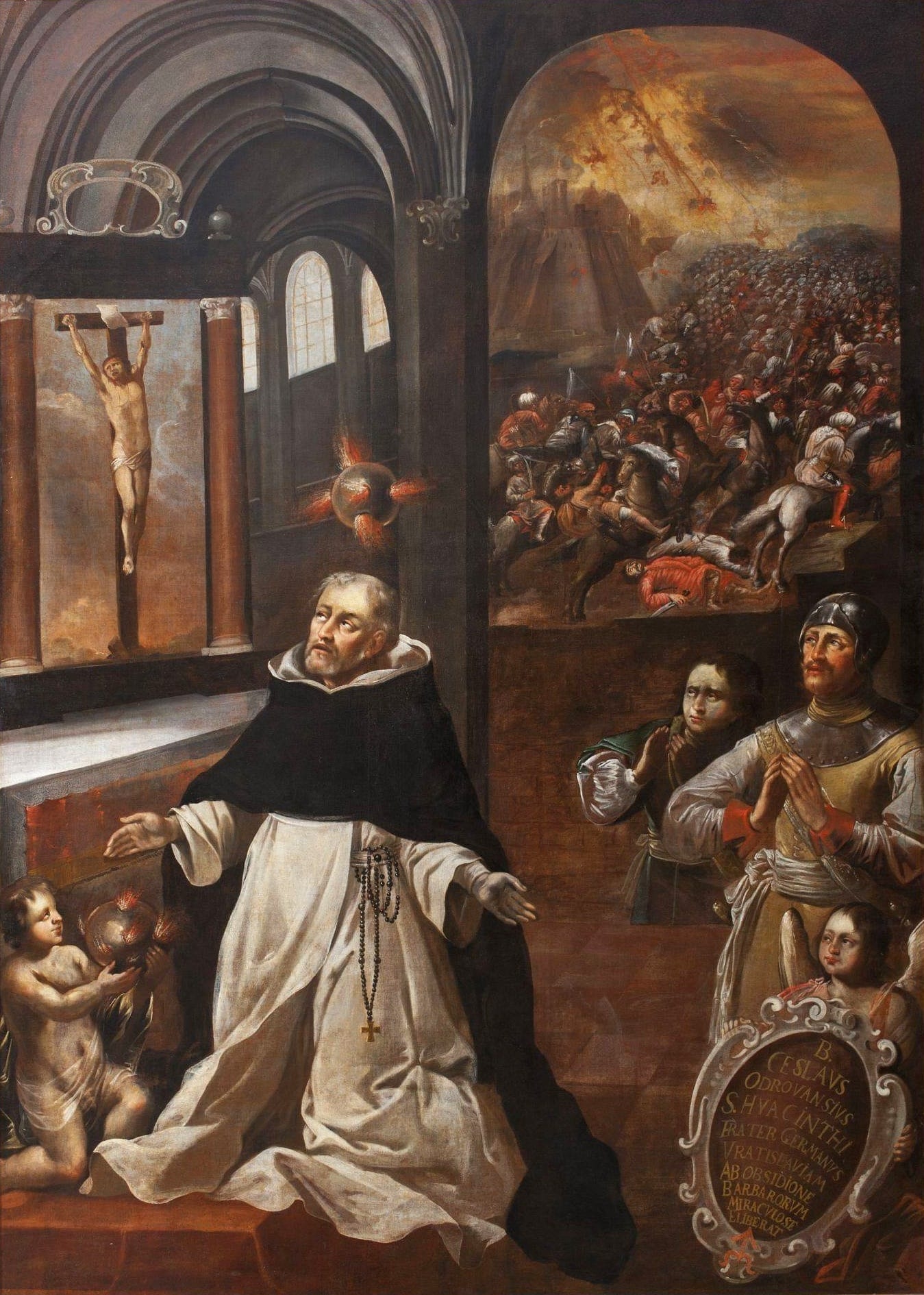
  • Sadoc and the 49 martyrs chanting the Salve Regina

    The mid-13th-century Polish Dominican prior in Dominican black-and-white habit at the altar of the Church of St. James at Sandomierz on the evening of June 2, 1260, leading the 48 companion-friars in the chanting of the Salve Regina, the Cuman-Tatar Mongol army bursting into the church behind them with drawn scimitars — the standard Polish Dominican iconography of the Sandomierz martyrs.

Patronages
The Polish Dominican Province (protomartyrs)Sandomierz and the Sandomierz region of PolandCatholic Mongol-invasion martyr-witnessesCatholic Salve Regina devotion (the famous Marian anthem chanted by the 49 Dominicans at the moment of their martyrdom)