
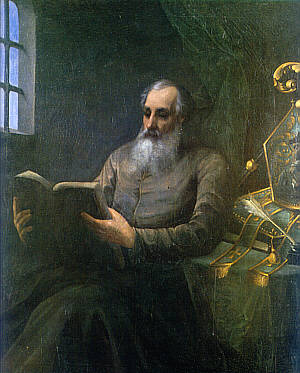
Sahak (Armenian Սահակ, Latin Isaacus, also Sahak Parthev) was the great-great-grandson of Gregory the Illuminator (the foundational apostle of Armenia and the figure under whose ministry Armenia became the first state in world history to formally adopt Christianity as official religion in 301 AD). Sahak was born around 354 at Caesarea Cappadocia, was educated at Constantinople in the Greek philosophical-theological tradition, married briefly, was widowed, and entered religious life around 380.
He was consecrated Catholicos (Patriarch) of All Armenians in 387 — the highest religious office of the Armenian Apostolic Church and the position his great-great-grandfather had held — and governed the Armenian Church for fifty-two years until his death in 439. His tenure coincided exactly with the catastrophic political partition of the historical Kingdom of Armenia in 387 between the Roman and Sasanian Persian empires (the Treaty of Acilisene), which divided the Armenian Christian community into two political-administrative spheres and threatened the long-term cultural-religious survival of the Armenian people.
Sahak's response to the political crisis was the great cultural-religious project of his pontificate: the creation of the Armenian alphabet and the systematic translation of the Bible into Armenian. He commissioned Mesrop Mashtots (see Mesrop's entry below) to develop a script specifically for the Armenian language; the alphabet was completed around 405 AD. Sahak then directed — with Mesrop as principal collaborator — the systematic translation of the entire Bible from the Greek Septuagint and the original Hebrew into Armenian over the next thirty years.
The Armenian Bible, completed around 433 AD, is one of the great early Christian biblical-textual achievements and one of the most beautiful translations in the entire Christian tradition (it has been called by 19th-century scholars 'the Queen of versions' for its philological precision and literary elegance). The translation has been the foundational cultural-religious document of the Armenian people across the 16 centuries since its completion. Sahak also directed the foundational systematic translation of the major Greek-Patristic theological literature into Armenian, preserving in the Armenian tradition substantial Greek-patristic texts that have been lost in the original Greek (most famously, the major surviving texts of Irenaeus of Lyon's Demonstration of the Apostolic Preaching and substantial portions of Origen's commentaries).