
Saturninus (Latin Saturninus, in Occitan Sernin — the form preserved in the Toulouse basilica's name) was sent — per the early Catholic tradition recorded by Gregory of Tours — to Gaul as part of the foundational Catholic mission of the mid-3rd century. He established himself at Toulouse around 245 AD as the first Bishop of the small Roman provincial capital of Tolosa.
Saturninus had to walk daily past the great pagan temple of the Roman Capitolium of Tolosa (the central pagan ritual building of the city, modelled on the Capitolium of Rome) to reach the small house-church he had established for the Toulousain Christian community. The pagan priests of the Capitolium complained that his daily passing — which they interpreted as a deliberate insult — was preventing their oracles from speaking. They eventually decided to force him to sacrifice publicly to their gods.
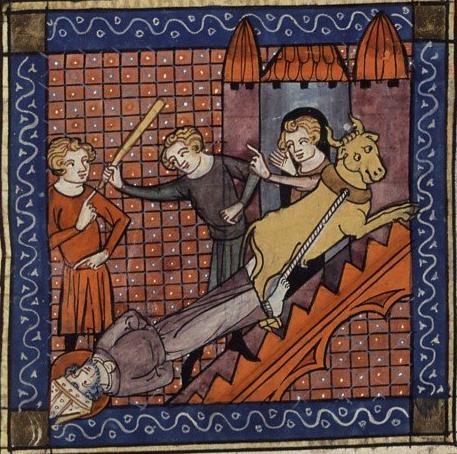
On the day chosen for a great pagan ritual at the Capitolium, the priests seized Saturninus as he passed and demanded that he sacrifice to their idol. He refused. They tied him to the legs of the sacrificial bull that had been prepared for the ceremony and released the maddened animal down the main street of the city (the modern Rue du Taur — 'Street of the Bull' — preserves the memory). Saturninus was dragged the length of the street and killed when his head broke against the cobblestones near what is now the site of the Basilica of Saint-Sernin. Two Christian women of the community gathered his body in a wooden coffin and buried him at the site that became the basilica.
The great 11th-century Romanesque Basilica of Saint-Sernin — one of the four foundational pilgrimage basilicas of the Camino de Santiago and one of the supreme Romanesque churches of southern France — was built over his original tomb. He is the foundational Catholic figure of the Toulousain church.