
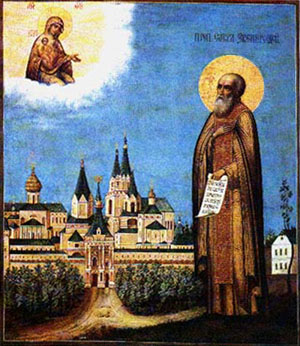
Sava was among the earliest disciples of Sergius of Radonezh, joining the Trinity Lavra in its first generation and serving for years as Sergius's confessor. When Sergius made the difficult decision to step down as abbot of the Trinity Lavra to live as a simple monk in his cell, Sava was elected abbot in his place. He governed the Lavra for six years.
In 1398 Prince Yuri Dmitrievich of Zvenigorod — son of Dmitry Donskoy — invited Sava to found a monastery in his appanage capital. Sava accepted, withdrew from the Trinity Lavra, and founded the Savvino-Storozhevsky monastery on Mount Storozhi above the Moskva river west of Moscow. Under his nine-year abbacy the monastery became one of the principal religious foundations of the Moscow grand-duchy, with its great Nativity Cathedral painted by Andrei Rublev and his workshop.
He is venerated as a 'wonderworker' (chudotvorets) in the Russian tradition, with a dense dossier of miracles attached to his shrine. The Storozhevsky monastery became the personal retreat of Tsar Alexei Mikhailovich in the 17th century (the tsar made annual pilgrimages on foot from Moscow), and continued as one of the principal Russian shrines until Soviet suppression. It was reopened in 1995.