Saint — Sebastian

St. Sebastian
c. 256, Narbonne, Gaul — c. 288, Rome (beaten to death after surviving the arrows)
Soldier-Martyr of Rome — Protector against Plague
Basilica of San Sebastiano fuori le Mura, Rome, Italy
Feast
January 20
✠ MartyrShot with arrows, survived, then beaten to death with clubs under Diocletian, c. 288 → The Martyrs
Life

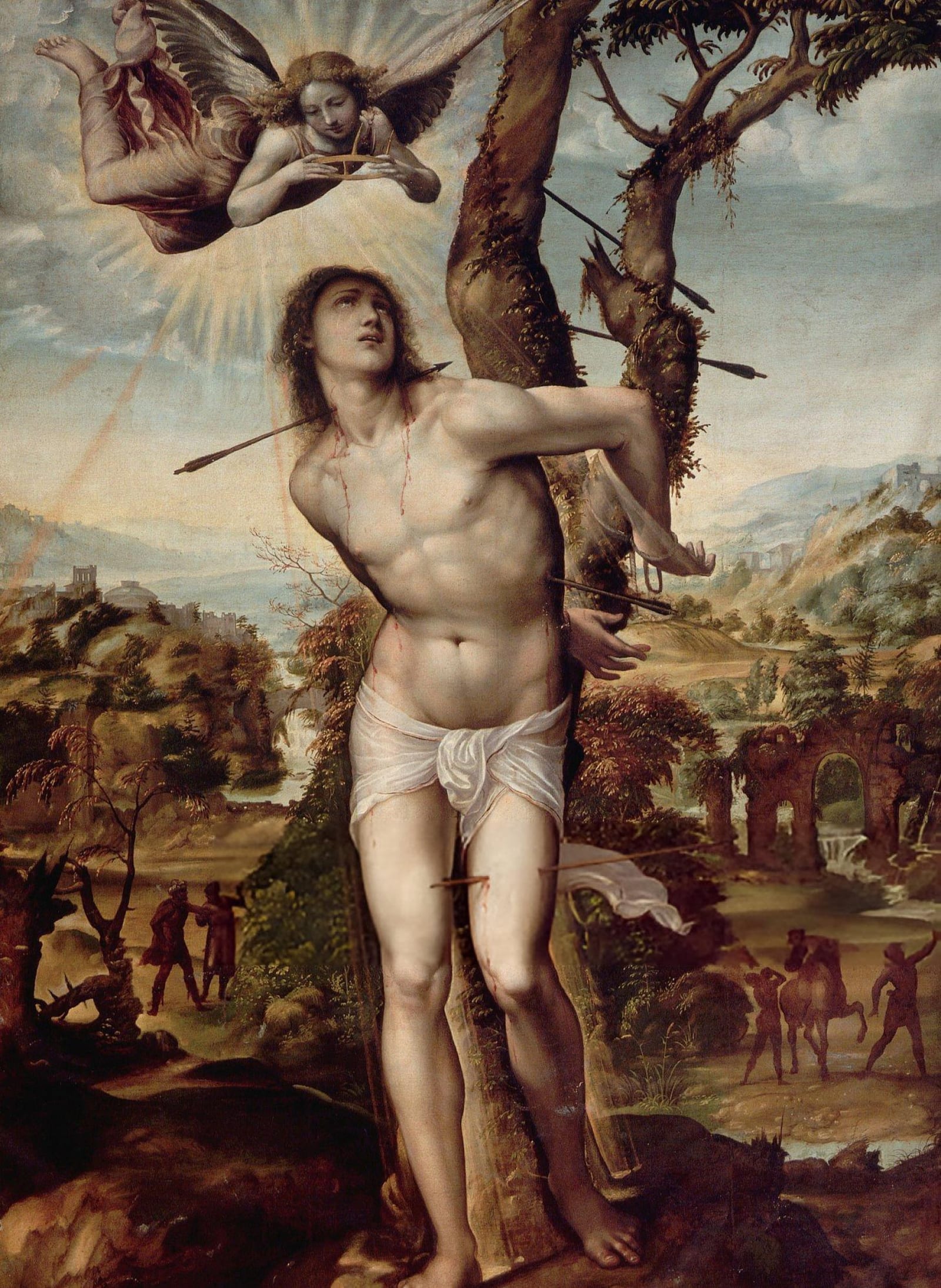
Sebastian was a Gallo-Roman officer in the Praetorian Guard under Diocletian. As a captain of the imperial palace guard, he secretly visited Christian prisoners, brought them sacraments, and used his position to protect them. When his Christianity was discovered, Diocletian ordered him bound to a stake and shot to death by archers.

He was pierced 'as full of arrows as a hedgehog of quills,' left for dead. The widow Irene of Rome, coming to take his body for burial, found him still alive and nursed him back to health. Restored, Sebastian sought out the emperor on the steps of the imperial palace and rebuked him for the persecution. Diocletian had him beaten to death with clubs; his body was cast into the Cloaca Maxima. A pious woman recovered it and buried him in the catacombs on the Appian Way.

His basilica on the Appian Way is one of the seven pilgrim churches of Rome. Together with St. Roch he is invoked particularly against plague — by the 14th-century black death his cult had become universal across Europe. His iconography — the beautiful young man pierced with arrows — became one of the most painted subjects of the Italian Renaissance.

Miracles & Phenomena
  • He survived the arrows

    The Acta record that Sebastian was bound and shot until he was left for dead — 'as full of arrows as a hedgehog of quills' — and that Irene of Rome, coming to bury him, found him alive and nursed him back to health. He then sought out Diocletian to rebuke him and was clubbed to death. The Acta were written long after his death, but the double martyrdom is the oldest and most consistent feature of his story, and it is why he is shown with arrows that did not kill him.

  • The plague at Pavia, 680

    Paul the Deacon records in his History of the Lombards that when plague devastated Pavia in 680 it ceased after an altar was raised to Sebastian in San Pietro in Vincoli at Rome and his relics were carried north. This is the origin of his patronage against plague — not his martyrdom, which has nothing to do with disease. The Golden Legend repeated the account in the thirteenth century, and by the Black Death his cult was universal across Europe.

Relics
  • Body
    Tomb of Sebastian
    Basilica of San Sebastiano fuori le Mura, Rome

    His tomb in the catacombs of the Appian Way is one of the seven pilgrim churches of Rome.

Iconography
  • Sebastian Tended by Irene

    The second great subject, and the quieter one: Irene of Rome drawing the arrows from him by lamplight. It belongs to the Baroque rather than the Renaissance — Ter Brugghen and Georges de La Tour are its masters — and it exists because the story does not end with the arrows.

  • Sebastian Pierced with Arrows

    The young Roman soldier bound to a tree, pierced with arrows — the most painted subject of the early Renaissance after the Crucifixion. Mantegna, Botticelli, Perugino, El Greco, Reni, Guido — all painted him.

Patronages
SoldiersArchersAthletesPlague victimsPolice officers
Sources & Further Reading