
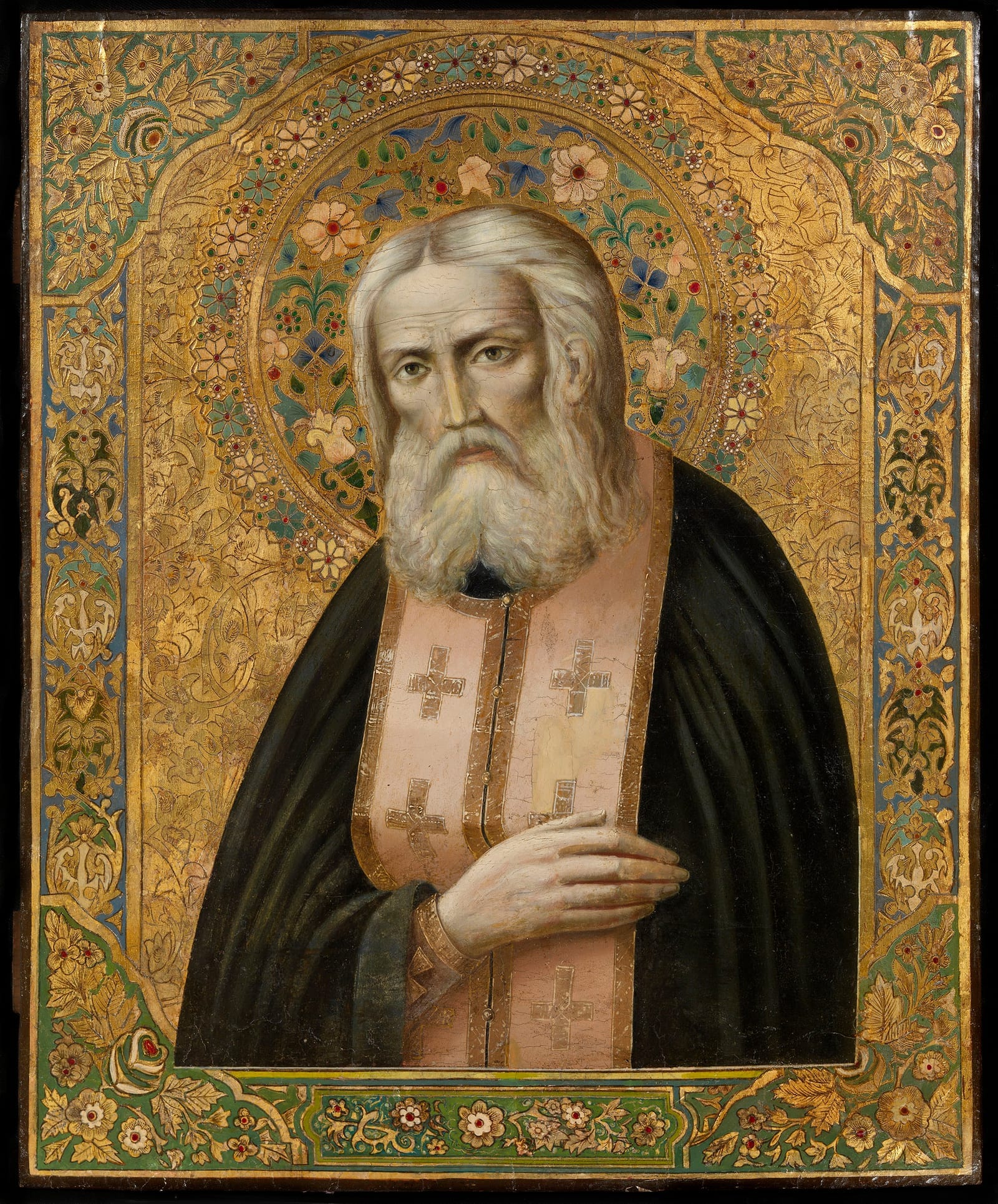
Prokhor Moshnin was born to a wealthy Kursk merchant family and entered the Sarov hermitage in the deep Mordovian forests northeast of Russia at twenty in 1778. He was tonsured monk in 1786 with the religious name Seraphim ('the fiery one'), ordained priest in 1793, and from 1794 lived for sixteen years as a forest hermit in a small log cell several miles from the Sarov monastery — observing extreme asceticism (a thousand-day continuous prayer on a stone, attested by tradition), feeding the local bears and other forest animals, and seeing no human company for years at a stretch.
In 1810 he returned to the Sarov monastery as a sealed recluse (zatvornik). For another fifteen years he saw no one. Then, around 1825, he opened his cell to visitors — and for the next eight years until his death received an extraordinary daily stream of Russian Orthodox pilgrims of every social class. His public spiritual teaching to them — collected in the Conversation with Motovilov of November 1831 (the foundational document of modern Russian Orthodox spirituality) — centered on what he called the 'acquisition of the Holy Spirit' as the entire purpose of Christian life: the soul's gradual transformation into the form of the Resurrected Christ through the personal indwelling of the Spirit.
He founded and directed the new women's monastery of Diveyevo a few miles from Sarov — which became, after his death, the principal Marian shrine of Russian Orthodox Christianity. He died at the Sarov hermitage on January 14, 1833. Canonized in 1903 by the Tsar Nicholas II in person at Sarov — the canonization at which Nicholas's wife Alexandra (long childless) is said to have prayed for an heir; the future Tsarevich Alexei was born the following year, then immediately diagnosed with haemophilia. Seraphim's relics were seized by the Soviets in 1920, rediscovered in storage in Leningrad in 1991, and translated back to Diveyevo in 1991 — where they remain. He is the central modern Russian Orthodox saint and the most-influential figure in the 20th-century Orthodox spiritual revival.