
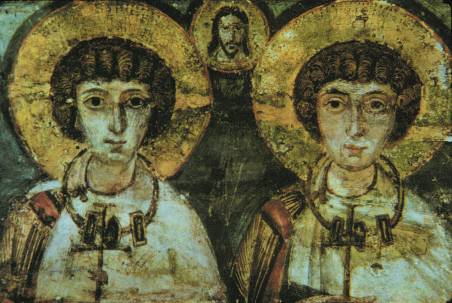
Sergius (Latin Sergius) and Bacchus (Latin Bacchus) were senior Roman military officers — primicerii of the schola gentilium (the imperial guard's foreign-recruits unit) — in the personal service of the Emperor Maximinus Daia in the Eastern Roman Empire. They were Christians and close personal friends, joined by the bonds of the formal adelphopoiia (Greek for 'brother-making') friendship-pact of the late-Roman period (a friendship-bond formalized in legal documentation, distinguishable in the historical record from but adjacent to the question of the broader ancient Mediterranean range of friendship-relationships — a question of substantial recent scholarly debate).
When Maximinus discovered their Christianity (per the foundational 5th-century Greek Passion of Sergius and Bacchus, the Emperor was informed of their absence from the pagan sacrifices that the imperial guard was required to attend), he ordered them publicly humiliated by being dressed in women's clothes and paraded through the streets of Augusta Euphratensis. They were then separated and sent to Resafa in the Syrian desert.
Bacchus was scourged to death at Resafa around 303. Sergius was then forced to run on hot iron-shod boots from Resafa to nearby Tetrapyrgium (about 18 miles) and back; he survived. He was finally beheaded at Resafa. The small town of Resafa was renamed Sergiopolis after him in the early 5th century, and became one of the great Syrian Christian pilgrimage sites of late antiquity — the Cathedral of Sergiopolis (built in the 5th–6th century, now a substantial ruin in the Syrian desert) was the foundation of Syrian-Christian pilgrim tradition for the Eastern Christians, the Arabs, and the medieval Christian Arabs of the Banu Ghassan kingdom.
Sergius is one of the few Christian saints to be also venerated in the Sunni Muslim folk-religious tradition (as Sergios al-Bahira) — the medieval Syrian Muslim tradition identifies him with the Christian monk Bahira who, in pre-Islamic Arabian tradition, recognized the future prophet Muhammad as a religious leader during his youthful journeys to Syria. The shared cult of Sergius across the Syrian Christian-Muslim religious boundary has been one of the most distinctive features of Syrian religious history.